It's been a weird summer in Norway. Weird, because it's been awesome. Weather-wise we are talking about the July of the century, or some such cliché. Sun has been had. Pale Norwegians soaked up vitamin D's to last us into the next decade, and for once I actually have tan lines on my back. We're normally used to summers where any outdoors plan always need an indoors alternative, but this time no such modification was called for.
July was spectacular.
August is looking for payback.
Frequently, August has been the warm and sunny month here. Just in time for school to start, summer kicked in, like a wonderful irony of life. This year, however, since July took August's job, August, apparently, decided to take September's. Ever since the start of the month we've had rain, wind, the occasional bout of sunshine, but then with the obvious promise of "plan B kind of day - expect to have to go indoors any moment". The cloudless days of July are long gone.
In a way I appreciate it. There is no doubt that it's really fall, summer is over, vacation time done, work takes the front seat. The transition is made somewhat easier by nature's clear message.
But then again - a few more weeks of sunshine, with the possibility of enjoying after-work-afternoons in a park instead of having to tote an umbrella everywhere - sounds nicer. August isn't playing nice this year.
There is, of course, absolutely nothing I can do about this. I can recall the lovely July, and I can curse the erratic August. In reality it makes no difference what I do. Winter is coming.
Showing posts with label Oslo. Show all posts
Showing posts with label Oslo. Show all posts
Thursday, August 15, 2013


Wednesday, May 15, 2013
On old acquaintances
The previous weekend I got to hang out with some old friends. One of them - let's call him Ken* - is Japanese and I met him when we were both attending university in a remote city of Japan, almost seven years ago.
Since we last saw each other our lives have taken very different turns. I returned to Norway to finish first my BA and then MA degree, I've had two other short-term stays abroad (one of them in Japan, but somehow we never managed to meet then, even though he didn't live very far from Tokyo), and I eventually started working at my alma mater here in Oslo, where I currently teach history.
Ken, on the other hand, graduated to become a somewhat classic Japanese business man, working for a big firm in Yokohama. He got married and he's got a son. Then, his company purchased part of a Norwegian shipping company, and as a result of this, they made Ken come work here. "Here" not meaning Oslo at all, but a small town on the western coast of Norway.
Even if it's on the other side of the country from Oslo, Ken is now living a whole lot closer to me than Japan, so we decided that it would be fun to meet up and hang out like the old days.
From our days at the uni in Japan I remember him as a boyish, charming, fun guy. We had a few classes together, and we'd frequently have lunch in the school cafeteria or go out drinking with a bigger group of friends. Meeting him again all these years later he had "grown up" more, but he was still fun and charming, and as easy to talk to as I remembered. For him, coming to Oslo after having lived the small town life for a few weeks was something of a luxury, and I think it's safe to say that it was a very successful weekend for all those involved.
When he was here we obviously wanted to show him not only Oslo by day (the Holmenkollen Ski Jump, the Opera, the Royal Palace and the Vigeland Park), but also Oslo by night. So we went out for dinner and later drinks on Saturday night.
Oslo by night isn't classy. It can be - there are places where the drinks are too expensive to get ridiculously drunk no matter how rich you are - but for the average Joe we go to places where the drinks are "only" expensive enough to make you have to mortgage your house after a drunken brawl. I'm only kidding a bit. (Foreigners tend to complain about the price level in general, but for alcohol in particular.)
Anyway, we managed to find several places that were okay, and we managed to make ourselves eligible for mortgages (had any of us been house owners). Eventually, after having been to a few other places first, we ended up in a bar I've never visited before. The place was packed, and the noise was almost unbearable. Since it was getting late and we had plans for Sunday morning as well (last chance for sightseeing!), we decided to only stay for one drink and then leave.
As I went to get mine, I passed a group of girls where one of them suddenly went into squeal mode. "OMG, it's you!" she exclaimed.
I knew her face. I knew where I knew her from. We went to high school together. I even knew the two girls she were with, also from high school. We exchanged some pleasantries, and then I quickly made an excuse and went on my way, even though she seemed eager to stay and chat about everything that had happened in our lives since we last met. I was more eager to get back to Ken and my other friends.
I didn't remember this girl's name, and it took me well into the next day (and perhaps a little Facebook research) before it came back to me. We were never close in high school; in fact, I'm not even sure we ever had a proper conversation back then. She was in a different crowd than me, and from the little I knew of her, I didn't much care for her. After not having seen her for almost ten years, neither of those things had changed.
Still, it hit me. This girl is my own age. We are from the same hometown and now we live in the same city. Looking at her Facebook profile (or the limited version of it, as we are not friends there either), we have approximately 60 or so friends in common. Some of which I count as good friends of mine.
Yet, despite having so much things in common, I have no desire to get to know her, and I don't care what she's made of herself. It makes no difference to me whether we see each other again in the next ten years or not.
Whereas Ken, whom I clearly do not have so much in common with - in fact, I have more or less nothing in common with him apart from the fact that we once attended the same university - I enjoyed seeing again. I hope to see him more times soon. I would like to meet his wife and son (who will move here from Japan soon). I think it's interesting to check out what he's been up to via Facebook, and I enjoy talking to him.
Personal chemistry is important, of course. I have that with the people I count among my close friends, several of them from high school. And I don't necessarily think I would have as fun with all my friends from Japan or elsewhere that I technically don't have very much in common with today, should I get to see them again.
But still, it intrigues me that it is so much easier to stay in touch with some people than others, and that with certain friends you don't have to talk with them very often - maybe once every seventh year - and things are still as they used to be. Fortunately.
*Actually, his name is Kensuke, but I noticed he introduced himself as Ken here in Norway, presumably because Norwegians would have trouble pronouncing his name. It's supposed to be "Ken-ske" rather than "Ken-su-ke" as we would say.
** The prize is to jump from the top of the Holmenkollen Ski Jump without skis or snow.
Still want to be that first person?
Since we last saw each other our lives have taken very different turns. I returned to Norway to finish first my BA and then MA degree, I've had two other short-term stays abroad (one of them in Japan, but somehow we never managed to meet then, even though he didn't live very far from Tokyo), and I eventually started working at my alma mater here in Oslo, where I currently teach history.
Ken, on the other hand, graduated to become a somewhat classic Japanese business man, working for a big firm in Yokohama. He got married and he's got a son. Then, his company purchased part of a Norwegian shipping company, and as a result of this, they made Ken come work here. "Here" not meaning Oslo at all, but a small town on the western coast of Norway.
Even if it's on the other side of the country from Oslo, Ken is now living a whole lot closer to me than Japan, so we decided that it would be fun to meet up and hang out like the old days.
From our days at the uni in Japan I remember him as a boyish, charming, fun guy. We had a few classes together, and we'd frequently have lunch in the school cafeteria or go out drinking with a bigger group of friends. Meeting him again all these years later he had "grown up" more, but he was still fun and charming, and as easy to talk to as I remembered. For him, coming to Oslo after having lived the small town life for a few weeks was something of a luxury, and I think it's safe to say that it was a very successful weekend for all those involved.
When he was here we obviously wanted to show him not only Oslo by day (the Holmenkollen Ski Jump, the Opera, the Royal Palace and the Vigeland Park), but also Oslo by night. So we went out for dinner and later drinks on Saturday night.
Oslo by night isn't classy. It can be - there are places where the drinks are too expensive to get ridiculously drunk no matter how rich you are - but for the average Joe we go to places where the drinks are "only" expensive enough to make you have to mortgage your house after a drunken brawl. I'm only kidding a bit. (Foreigners tend to complain about the price level in general, but for alcohol in particular.)
Anyway, we managed to find several places that were okay, and we managed to make ourselves eligible for mortgages (had any of us been house owners). Eventually, after having been to a few other places first, we ended up in a bar I've never visited before. The place was packed, and the noise was almost unbearable. Since it was getting late and we had plans for Sunday morning as well (last chance for sightseeing!), we decided to only stay for one drink and then leave.
As I went to get mine, I passed a group of girls where one of them suddenly went into squeal mode. "OMG, it's you!" she exclaimed.
I knew her face. I knew where I knew her from. We went to high school together. I even knew the two girls she were with, also from high school. We exchanged some pleasantries, and then I quickly made an excuse and went on my way, even though she seemed eager to stay and chat about everything that had happened in our lives since we last met. I was more eager to get back to Ken and my other friends.
I didn't remember this girl's name, and it took me well into the next day (and perhaps a little Facebook research) before it came back to me. We were never close in high school; in fact, I'm not even sure we ever had a proper conversation back then. She was in a different crowd than me, and from the little I knew of her, I didn't much care for her. After not having seen her for almost ten years, neither of those things had changed.
Still, it hit me. This girl is my own age. We are from the same hometown and now we live in the same city. Looking at her Facebook profile (or the limited version of it, as we are not friends there either), we have approximately 60 or so friends in common. Some of which I count as good friends of mine.
Yet, despite having so much things in common, I have no desire to get to know her, and I don't care what she's made of herself. It makes no difference to me whether we see each other again in the next ten years or not.
Whereas Ken, whom I clearly do not have so much in common with - in fact, I have more or less nothing in common with him apart from the fact that we once attended the same university - I enjoyed seeing again. I hope to see him more times soon. I would like to meet his wife and son (who will move here from Japan soon). I think it's interesting to check out what he's been up to via Facebook, and I enjoy talking to him.
Personal chemistry is important, of course. I have that with the people I count among my close friends, several of them from high school. And I don't necessarily think I would have as fun with all my friends from Japan or elsewhere that I technically don't have very much in common with today, should I get to see them again.
But still, it intrigues me that it is so much easier to stay in touch with some people than others, and that with certain friends you don't have to talk with them very often - maybe once every seventh year - and things are still as they used to be. Fortunately.
 |
| Sometimes friendship is like a ski jump without snow. Mostly, it's not. (I'm in this picture. Or my foot is. The first person to find it gets a prize!**) |
*Actually, his name is Kensuke, but I noticed he introduced himself as Ken here in Norway, presumably because Norwegians would have trouble pronouncing his name. It's supposed to be "Ken-ske" rather than "Ken-su-ke" as we would say.
** The prize is to jump from the top of the Holmenkollen Ski Jump without skis or snow.
Still want to be that first person?
Saturday, September 22, 2012
On biscotti and being right
Today I visited for the first time a new coffee shop that's popped up in my neighbourhood.
It's not like we were lacking coffee shops as it was. There are probably at least ten or fifteen in a 1km radius from my house, and that's not even counting any of the places that are more restaurants or cafés than coffee shops.
But, evidently, we needed one more.
Granted, this one is different from many of the others. A few selected chains have a definite majority of the market here, while this is an indie shop. Also, while many other coffee shops focus on offering plenty of seats for their customers, this one goes the other way around. They offer no one.
It's a take-away joint, exclusively.
As I'm sure a significant portion of the market is take-away I suppose this makes no huge difference for the income for this little shop - they would at any rate not be able to serve many sit-in customers in such a tiny venue.
Still, this poses a new challenge for us as customers. I'm used to now, from years of being a coffee drinker, to always specify whether I want my coffee to-go or not. In this case, though, such details are redundant, as the barista kindly informed me.
I say "kindly" because that's what it was, or at least, that was the intention. Clearly, the barista used this extra information I provided automatically (and I'm sure I'm not the first to do so) as an ice-breaker of sorts, a way of chatting friendlily (which really ought to be a word. "Friendlily" is vastly different from "friendly", just saying...) with the customers.
Well, we chatted. Friendlily. I put up a calm face, and I'm certain that the barista thought I was being sincere. All the while standing there, however, I felt a burning desire to quarrel. It wasn't so much that I'd been caught stating the obvious as it was a reaction to low blood sugar and a result of a certain irrationality I've always carried with me. I'm not proud of it. But there you go.
Anyway, what she told me, this barista, was that the reason there was no need to specify whether one wanted to go or not (or rather, paper or porcelain) was that for coffee shops here in Oslo there is a rule, apparently, that you cannot serve in stoneware if you don't have a customer bathroom (!).
We collectively shook our heads at these silly rules, and she even had me there for a moment, forgetting that I was irrational and quarrelsome, and instead making jokes about how the authorities seems to overstate the correlation between people's need to pee when drinking from mugs instead of paper cups.
At this point we had reached the pay-part of the transaction, and I pulled out my wallet. Just before she put the (paper) cup on the desk in front of me, however, I decided that I also wanted something to go with my coffee.
"I'll take one of those as well," I said, pointing at a big jar of biscotti which was conveniently placed next to the register.
"Oh," she said, "now you've done it."
Turns out there was a consensus among customers and employees alike that these were the world's tastiest biscotti, and that it was virtually impossible to have just one. Not being one to back out of a challenge, however, I remained fixed on the idea of buying one - 1 - biscotti. Thus I did, and then I left.
I'd only walked about a block when I realized that there is a coffee shop not 200 metres from the one I visited today which doesn't have a customer bathroom either. It does, however, serve its coffee in porcelain mugs if you ask for it. Slightly annoyed that I hadn't thought of this earlier, I considered briefly turning around and letting the barista know that she was wrong/I was right/she couldn't get away with such lies. However, the need to actually taste my coffee (I've always found that the problem with take-away coffee is that it is quite difficult to drink and walk at the same time, and it thus often turns into "take-somewhere-else-and-then-drink" coffee for me) prevailed. I returned home instead.
There I tasted the world's tastiest biscotti.
Turns out they weren't lying about this in the coffee shop. It really is the yummiest biscotti I've ever had, and I seriously doubt it's possible that anyone else, anywhere else in time or space has had any yummier.
Now I have two reasons to return to the coffee shop. First, the biscotti. Clearly, it is (near?) impossible to eat just one. I've been craving another for the two hours that's passed since I had the first. Secondly, I still have an urge to go back and tell the barista that there is another coffee shop in the vicinity that doesn't have a customer bathroom but does have mugs.
My problem is this: the two reasons to go back go poorly together. I worry that I might be denied the right to buy another biscotti if I am rude and explains how she was wrong. But if I go back to only buy the biscotti, and not make the remark about the other coffee shop, I fear that I will explode. So far, the only solution I can think of is denying myself both these pleasures - biscotti and being a bossy know-it-all - since I cannot have them together. I can only hope that with time the desire for either one will fade and I can return to other considerations in life.
Also, I need to find a proper translation for the Norwegian word "kverulant".
It's not like we were lacking coffee shops as it was. There are probably at least ten or fifteen in a 1km radius from my house, and that's not even counting any of the places that are more restaurants or cafés than coffee shops.
But, evidently, we needed one more.
Granted, this one is different from many of the others. A few selected chains have a definite majority of the market here, while this is an indie shop. Also, while many other coffee shops focus on offering plenty of seats for their customers, this one goes the other way around. They offer no one.
It's a take-away joint, exclusively.
As I'm sure a significant portion of the market is take-away I suppose this makes no huge difference for the income for this little shop - they would at any rate not be able to serve many sit-in customers in such a tiny venue.
Still, this poses a new challenge for us as customers. I'm used to now, from years of being a coffee drinker, to always specify whether I want my coffee to-go or not. In this case, though, such details are redundant, as the barista kindly informed me.
I say "kindly" because that's what it was, or at least, that was the intention. Clearly, the barista used this extra information I provided automatically (and I'm sure I'm not the first to do so) as an ice-breaker of sorts, a way of chatting friendlily (which really ought to be a word. "Friendlily" is vastly different from "friendly", just saying...) with the customers.
Well, we chatted. Friendlily. I put up a calm face, and I'm certain that the barista thought I was being sincere. All the while standing there, however, I felt a burning desire to quarrel. It wasn't so much that I'd been caught stating the obvious as it was a reaction to low blood sugar and a result of a certain irrationality I've always carried with me. I'm not proud of it. But there you go.
Anyway, what she told me, this barista, was that the reason there was no need to specify whether one wanted to go or not (or rather, paper or porcelain) was that for coffee shops here in Oslo there is a rule, apparently, that you cannot serve in stoneware if you don't have a customer bathroom (!).
We collectively shook our heads at these silly rules, and she even had me there for a moment, forgetting that I was irrational and quarrelsome, and instead making jokes about how the authorities seems to overstate the correlation between people's need to pee when drinking from mugs instead of paper cups.
At this point we had reached the pay-part of the transaction, and I pulled out my wallet. Just before she put the (paper) cup on the desk in front of me, however, I decided that I also wanted something to go with my coffee.
"I'll take one of those as well," I said, pointing at a big jar of biscotti which was conveniently placed next to the register.
"Oh," she said, "now you've done it."
Turns out there was a consensus among customers and employees alike that these were the world's tastiest biscotti, and that it was virtually impossible to have just one. Not being one to back out of a challenge, however, I remained fixed on the idea of buying one - 1 - biscotti. Thus I did, and then I left.
I'd only walked about a block when I realized that there is a coffee shop not 200 metres from the one I visited today which doesn't have a customer bathroom either. It does, however, serve its coffee in porcelain mugs if you ask for it. Slightly annoyed that I hadn't thought of this earlier, I considered briefly turning around and letting the barista know that she was wrong/I was right/she couldn't get away with such lies. However, the need to actually taste my coffee (I've always found that the problem with take-away coffee is that it is quite difficult to drink and walk at the same time, and it thus often turns into "take-somewhere-else-and-then-drink" coffee for me) prevailed. I returned home instead.
There I tasted the world's tastiest biscotti.
Turns out they weren't lying about this in the coffee shop. It really is the yummiest biscotti I've ever had, and I seriously doubt it's possible that anyone else, anywhere else in time or space has had any yummier.
Now I have two reasons to return to the coffee shop. First, the biscotti. Clearly, it is (near?) impossible to eat just one. I've been craving another for the two hours that's passed since I had the first. Secondly, I still have an urge to go back and tell the barista that there is another coffee shop in the vicinity that doesn't have a customer bathroom but does have mugs.
My problem is this: the two reasons to go back go poorly together. I worry that I might be denied the right to buy another biscotti if I am rude and explains how she was wrong. But if I go back to only buy the biscotti, and not make the remark about the other coffee shop, I fear that I will explode. So far, the only solution I can think of is denying myself both these pleasures - biscotti and being a bossy know-it-all - since I cannot have them together. I can only hope that with time the desire for either one will fade and I can return to other considerations in life.
Also, I need to find a proper translation for the Norwegian word "kverulant".
Monday, July 2, 2012
On vacation
I am not. On vacation, that is. Or holiday if you prefer. I'm not on either. I'm in Oslo, not travelling, not not working (but not really working that much either).
The reasons for this are severalfold.
First of all, formally I don't have the "right" for vacation this year. A paid one, that is. Per our system you ear money for a paid leave each year, but it is earned from the previous year's salary. Since I started my current job in January I don't qualify this year. I could still have taken an unpaid vacation, of course, but how in the would I then cover my rent? So, instead I applied for not having to take out any vacation this year. The problem with this is, of course, that as a teacher I don't really have that much to do between semesters. I can (and should) obviously prepare for the next semester. I do. I read. And think. And look out the window. And have another coffee. And then read some more. But in reality, my motivation is nowhere to be found. The semester feels so faaaaaar away (though it isn't!).
Aside from not technically having earned a vacation this year I am not sure I would have gone anywhere even if I'd had the time off. Time isn't the only thing I'd have to earn, after all - travelling is expensive (especially since I become even less inclined to watch my spending when on vacation). Even thought I have a decent salary now, I haven't gotten used to the idea of having money yet (it's a tough transition, I tell ya, from having lived for years as a poor student, and now money magically shows up in my account every month. Why wouldn't I spend it all at once??). Saving money? Wouldn't even know how. Okay, that's not entirely true. I do save money. But it's more for the endless black hole labelled "future" than the current fancy labelled "vacation".
Third, and this is somewhat connected to the previous point - I am a terrible planner. Terrible. To me, booking flight tickets feels like a life or death decision (and not because I'm scared of flying - no, it's the commitment that freaks me out). I don't like planning more than, say, a week ahead. Having tickets for something months ahead is the same as saying no to something else that might show up (it's a terrible habit, I know). At the same time, though, I'm not at all impulsive. The idea of going to the airport and just get a ticket to the first and best place you find is almost as scary to me as actually planning that trip ahead... And still I love to travel - you try to figure it out!
So, to sum up - I'm not on vacation because I don't have the time, I don't have the money and because I absolutely suck at planning these things. The first two might and will change with time - the third I'm not so sure about. I guess I just have to suck it up and accept that sometimes planning ahead is okay. In the meantime I've managed to enjoy some vacation-ish time right here in Oslo the previous week. With visiting several museums, going to the cinema, shopping (though not for souvenirs...) and eating more ice cream than what's good for me, I've pretty much covered the tourism part anyway.
The reasons for this are severalfold.
First of all, formally I don't have the "right" for vacation this year. A paid one, that is. Per our system you ear money for a paid leave each year, but it is earned from the previous year's salary. Since I started my current job in January I don't qualify this year. I could still have taken an unpaid vacation, of course, but how in the would I then cover my rent? So, instead I applied for not having to take out any vacation this year. The problem with this is, of course, that as a teacher I don't really have that much to do between semesters. I can (and should) obviously prepare for the next semester. I do. I read. And think. And look out the window. And have another coffee. And then read some more. But in reality, my motivation is nowhere to be found. The semester feels so faaaaaar away (though it isn't!).
Aside from not technically having earned a vacation this year I am not sure I would have gone anywhere even if I'd had the time off. Time isn't the only thing I'd have to earn, after all - travelling is expensive (especially since I become even less inclined to watch my spending when on vacation). Even thought I have a decent salary now, I haven't gotten used to the idea of having money yet (it's a tough transition, I tell ya, from having lived for years as a poor student, and now money magically shows up in my account every month. Why wouldn't I spend it all at once??). Saving money? Wouldn't even know how. Okay, that's not entirely true. I do save money. But it's more for the endless black hole labelled "future" than the current fancy labelled "vacation".
Third, and this is somewhat connected to the previous point - I am a terrible planner. Terrible. To me, booking flight tickets feels like a life or death decision (and not because I'm scared of flying - no, it's the commitment that freaks me out). I don't like planning more than, say, a week ahead. Having tickets for something months ahead is the same as saying no to something else that might show up (it's a terrible habit, I know). At the same time, though, I'm not at all impulsive. The idea of going to the airport and just get a ticket to the first and best place you find is almost as scary to me as actually planning that trip ahead... And still I love to travel - you try to figure it out!
So, to sum up - I'm not on vacation because I don't have the time, I don't have the money and because I absolutely suck at planning these things. The first two might and will change with time - the third I'm not so sure about. I guess I just have to suck it up and accept that sometimes planning ahead is okay. In the meantime I've managed to enjoy some vacation-ish time right here in Oslo the previous week. With visiting several museums, going to the cinema, shopping (though not for souvenirs...) and eating more ice cream than what's good for me, I've pretty much covered the tourism part anyway.
Thursday, December 8, 2011
On decency and safety: how playing it safe occasionally is hazardous
This is a tale of the importance of a safety pin, and how choosing safety in one department, very well might put you at risk in another.
Let me first dwell over the expression "safety pin". It is "a spring wire clasp with a covering catch, made so as to shield the point when closed and to prevent accidental unfastening"[1]. So true. A safety pin is meant to prevent accidental unfastening. What this definition fails to convey, however, is that a safety pin generally also is meant to prevent accidental unfastening of the item(s) it is holding together.
For instance. I have a reflex.
Digression: I know the word "reflex" in English means many things - none of which is the one I need it to mean. (Actually, I have many reflexes. None that are shaped like a giraffe, incidentally. This is not relevant to the digression or the story, though. It's a sub-digression.)
The word I need is tricky to find. I've been stumbling around google for a while, and the best I could come up with is "reflective item". That sounds overly complicated for someone who grew up with government initiated campaigns ("Reflexes save lives!") to make people wear these reflective items to increase traffic security. I feel this says something about the English speaking world. Most of it is located much further south than the Norwegian speaking world (which mainly is located in Norway). Further south means more light during winter. But, it just occurred to me, further south also means less light during summer, so technically, they ought to use their reflective items all year round, and not just in winter, like we do! Also - what about Alaska?!
Yes, what about Alaska?
Alaska is English speaking, and far north. They would suffer from similar reflective issues as we do in Norway. They need to wear reflective items too. But there is no way you'd make an Alaskan put on what a Norwegian would refer to as a "reflex" unless they have a better name for it. I can imagine the government initiated campaigns in Alaska:
"Use a reflective item! If you can pronounce it fast enough; it might save your life!"
Not that the pronounciation matters, technically, to how efficient it is at reflecting light and thus making you visible to cars and thus increasing traffic security...
I think I lost a part of myself in that digression. (I also forgot to pull back in the string about the south-of-Alaska part of the English-speaking world needing reflexes year-round. I just don't know. Do they?)
Anyway. Since I didn't grow up in Alaska, or anywhere else in the English speaking world, I know that you have to wear a reflex all through winter. It might save your life. Or mine. Every autumn, then, I dutifully put on the little not-giraffe-shaped thingie, and so far I've never been killed by a car.
However, that might be subject to change.
On Monday my workplace had its annual Christmas Party.
Digression again: I know I haven't been talking about my job much. At least not this job. The job I now have. The job with the Christmas Party safety issues. I went directly from "Back from Japan, new opportunities will come" via "Ihatelookingforajob!!!" to "Istillhatelookingforajob!!!!!" to "So, on my way to work today..." to near-radio silence. I know. So much for blogging being all about sharing stuff, right..?
I got a job. I got a job that under no circumstances made me feel like sharing anything at all. Partly because it was top-secret (it wasn't. That just sounded more interesting than what I was about to type...) - Partly because it was temporary. One month only. Then one month more. Never enough to actually let my shoulders down. Not even enough to find an apartment in Oslo.
So, I've been living with my parents, still (most of my stuff is there), but in reality, I've spent more time living at either one of my sisters' houses, plus occasionally crashing on various couches. I am grateful for their hospitality, but obviously, the situation isn't ideal. It's exhausting, and the only reason I tolerate it is that the alternative would be a four-hour commute, daily. As it is, I "only" have a two hour commute.
The other reason I haven't felt like sharing much about this job is that it isn't... it isn't what I wanted to do. The job itself is fine. I occasionally like it, I occasionally don't. Like any other job, then. I don't ever feel I work enough, or that my results are sufficient - like any other job, then. It's challenging, tiresome, and fairly interesting. Like any other job. Then.
As happy as I am to have a job, I am slightly - surprised, perhaps - that I'm still at my old university. Many of my classmates fell in love with the process of academia. I didn't. I wanted to use it to get an education, and then get out. All hail those who want to become scientists and researchers, but that was never me.
And yet. Here I am. Back in academia, back in research. I'm writing footnotes like my life depended on it. (Actually, no, that is a stretch. My life depends on wearing a reflex. Not footnotes.)
It's been an interesting shift from being a student to being a colleague. Of sorts. I'm still the lowest ranking here, of course; but all of a sudden I'm two floors up from before, I have xerox and printer access I could only dream of as a student (I did), and the noble professors now greet me when I run into them in the hallways. Plus I got invited to the Christmas Party.
At first I didn't sign up; after all, I was here for a short time only. But then something changed. I got a new job.
This time it's for six months. I know that's still temporary, but to me, it sounds like a world of time. More interestingly, perhaps - it's not about footnotes anymore. It's teaching. Classes. University classes. With actual students. Students who will be graded. By me.
It feels - overwhelming. Great responsibility, massive amounts of work, and a situation that will be completely new to me. I've asked myself whether I am qualified for this - heck, I asked my boss whether I am qualified. We reached the conclusion that I am... Now I only need to prove it. Am I scared? No, I'm terrified. But I am also determined to do my best.
Academia pulled me back in again. I guess this will be my chance to find out whether my decision not to devote my life to academics was right.
In the meantime my concern lies more with reflexes and safety pins. You see, my reflex - of the not-giraffe variety - is fastened in my coat with a safety pin. Usually, then, this safety pin keeps me safe. However, for the Christmas Party I needed safety in a whole different way. Since I signed up late for the Christmas Party (having changed my mind when I realized I'd be working here six more months), I didn't have much time to figure out what to wear. I went with what appeared to be a safe choice: the little black dress.
Every girl should own one. So versatile, so classic. And in my case, so revealing... I hadn't realized just how revealing it was until I wore it a few days earlier, and noticed this dress took the concept of cleavage to a whole new level. There was no way I could sport that at a Christmas Party for a new job.
So, a safety pin was my rescue. My rescue and near demise. Because I only had the one - the one from the reflex.
The safety pin kept the dress in place, thus fulfilling its purpose of preventing accidental unfastening. But since I had to remove the reflex from my coat in order to maintain the desired level of decency, I ran a risk with safety. Without the reflex, I was near invisible to a car passing me on the street later that same night. If I had been killed, we would have had decisive evidence to two hypotheses:
"Reflexes save lives"; and
"Putting decency first, makes safety worst."
I'm not sure the latter would be appropriate or desirable in a government initiated campaign. It depends on what sort of campaign it is, I suppose.
The Christmas Party went well. I still have a job. My decency is safe. And so will I be, if I can only remember to put my reflex back on my coat. Then I can return to my habit of not being killed by cars.
Let me first dwell over the expression "safety pin". It is "a spring wire clasp with a covering catch, made so as to shield the point when closed and to prevent accidental unfastening"[1]. So true. A safety pin is meant to prevent accidental unfastening. What this definition fails to convey, however, is that a safety pin generally also is meant to prevent accidental unfastening of the item(s) it is holding together.
For instance. I have a reflex.
Digression: I know the word "reflex" in English means many things - none of which is the one I need it to mean. (Actually, I have many reflexes. None that are shaped like a giraffe, incidentally. This is not relevant to the digression or the story, though. It's a sub-digression.)
The word I need is tricky to find. I've been stumbling around google for a while, and the best I could come up with is "reflective item". That sounds overly complicated for someone who grew up with government initiated campaigns ("Reflexes save lives!") to make people wear these reflective items to increase traffic security. I feel this says something about the English speaking world. Most of it is located much further south than the Norwegian speaking world (which mainly is located in Norway). Further south means more light during winter. But, it just occurred to me, further south also means less light during summer, so technically, they ought to use their reflective items all year round, and not just in winter, like we do! Also - what about Alaska?!
Yes, what about Alaska?
Alaska is English speaking, and far north. They would suffer from similar reflective issues as we do in Norway. They need to wear reflective items too. But there is no way you'd make an Alaskan put on what a Norwegian would refer to as a "reflex" unless they have a better name for it. I can imagine the government initiated campaigns in Alaska:
"Use a reflective item! If you can pronounce it fast enough; it might save your life!"
Not that the pronounciation matters, technically, to how efficient it is at reflecting light and thus making you visible to cars and thus increasing traffic security...
I think I lost a part of myself in that digression. (I also forgot to pull back in the string about the south-of-Alaska part of the English-speaking world needing reflexes year-round. I just don't know. Do they?)
Anyway. Since I didn't grow up in Alaska, or anywhere else in the English speaking world, I know that you have to wear a reflex all through winter. It might save your life. Or mine. Every autumn, then, I dutifully put on the little not-giraffe-shaped thingie, and so far I've never been killed by a car.
However, that might be subject to change.
On Monday my workplace had its annual Christmas Party.
Digression again: I know I haven't been talking about my job much. At least not this job. The job I now have. The job with the Christmas Party safety issues. I went directly from "Back from Japan, new opportunities will come" via "Ihatelookingforajob!!!" to "Istillhatelookingforajob!!!!!" to "So, on my way to work today..." to near-radio silence. I know. So much for blogging being all about sharing stuff, right..?
I got a job. I got a job that under no circumstances made me feel like sharing anything at all. Partly because it was top-secret (it wasn't. That just sounded more interesting than what I was about to type...) - Partly because it was temporary. One month only. Then one month more. Never enough to actually let my shoulders down. Not even enough to find an apartment in Oslo.
So, I've been living with my parents, still (most of my stuff is there), but in reality, I've spent more time living at either one of my sisters' houses, plus occasionally crashing on various couches. I am grateful for their hospitality, but obviously, the situation isn't ideal. It's exhausting, and the only reason I tolerate it is that the alternative would be a four-hour commute, daily. As it is, I "only" have a two hour commute.
The other reason I haven't felt like sharing much about this job is that it isn't... it isn't what I wanted to do. The job itself is fine. I occasionally like it, I occasionally don't. Like any other job, then. I don't ever feel I work enough, or that my results are sufficient - like any other job, then. It's challenging, tiresome, and fairly interesting. Like any other job. Then.
As happy as I am to have a job, I am slightly - surprised, perhaps - that I'm still at my old university. Many of my classmates fell in love with the process of academia. I didn't. I wanted to use it to get an education, and then get out. All hail those who want to become scientists and researchers, but that was never me.
And yet. Here I am. Back in academia, back in research. I'm writing footnotes like my life depended on it. (Actually, no, that is a stretch. My life depends on wearing a reflex. Not footnotes.)
It's been an interesting shift from being a student to being a colleague. Of sorts. I'm still the lowest ranking here, of course; but all of a sudden I'm two floors up from before, I have xerox and printer access I could only dream of as a student (I did), and the noble professors now greet me when I run into them in the hallways. Plus I got invited to the Christmas Party.
At first I didn't sign up; after all, I was here for a short time only. But then something changed. I got a new job.
This time it's for six months. I know that's still temporary, but to me, it sounds like a world of time. More interestingly, perhaps - it's not about footnotes anymore. It's teaching. Classes. University classes. With actual students. Students who will be graded. By me.
It feels - overwhelming. Great responsibility, massive amounts of work, and a situation that will be completely new to me. I've asked myself whether I am qualified for this - heck, I asked my boss whether I am qualified. We reached the conclusion that I am... Now I only need to prove it. Am I scared? No, I'm terrified. But I am also determined to do my best.
Academia pulled me back in again. I guess this will be my chance to find out whether my decision not to devote my life to academics was right.
In the meantime my concern lies more with reflexes and safety pins. You see, my reflex - of the not-giraffe variety - is fastened in my coat with a safety pin. Usually, then, this safety pin keeps me safe. However, for the Christmas Party I needed safety in a whole different way. Since I signed up late for the Christmas Party (having changed my mind when I realized I'd be working here six more months), I didn't have much time to figure out what to wear. I went with what appeared to be a safe choice: the little black dress.
Every girl should own one. So versatile, so classic. And in my case, so revealing... I hadn't realized just how revealing it was until I wore it a few days earlier, and noticed this dress took the concept of cleavage to a whole new level. There was no way I could sport that at a Christmas Party for a new job.
So, a safety pin was my rescue. My rescue and near demise. Because I only had the one - the one from the reflex.
The safety pin kept the dress in place, thus fulfilling its purpose of preventing accidental unfastening. But since I had to remove the reflex from my coat in order to maintain the desired level of decency, I ran a risk with safety. Without the reflex, I was near invisible to a car passing me on the street later that same night. If I had been killed, we would have had decisive evidence to two hypotheses:
"Reflexes save lives"; and
"Putting decency first, makes safety worst."
I'm not sure the latter would be appropriate or desirable in a government initiated campaign. It depends on what sort of campaign it is, I suppose.
The Christmas Party went well. I still have a job. My decency is safe. And so will I be, if I can only remember to put my reflex back on my coat. Then I can return to my habit of not being killed by cars.
Sunday, October 9, 2011

Tuesday, July 26, 2011
This is Norway
The past few days I have seen the worst and the best of mankind.
It started with the worst. With terrorism, hate, fear.
But it quickly turned around, into a show of strength far superior to that of one individual's hatred. It was the will of an entire people - and with us an entire world - who chose love, solidarity, democracy to battle terrorism.
"We meet terror and violence with more democracy and will continue to fight against intolerance," our Prime Minister said. And the people replied. By organizing hundreds of events in support of the victims. By speaking out in public, or by use of social platforms like Twitter and Facebook. By standing together, in rain and sunshine throughout the weekend, in Oslo and around the country (and also abroad). The sea of roses in front of one of Oslo's churches grew from a few hundred to thousands and thousands in the course of a few days. And then the rose march yesterday - taking place simultaneously in Oslo and the rest of the country. We're a small country, of only 4,6 million people. About 1 million of us were out marching with roses or candles yesterday. Even though we're not many, though, even though we're small; we're also big. Together we are more than 1 million roses, more than 4,6 million people. We're a nation coming together in a time of grief.
Another inspiring quote that has circulated these past few days is from one of the young politicians who was at the Utøya camp on Friday: "If one man can show so much hate, imagine how much love we could show, standing together."
This is exactly what we are now doing.
Matching our solidarity and love, however, must also be what our Prime Minister called for: democracy.
According to our laws, the maximum punishment the culprit from Friday's terror actions can get is 21 years (though there is the possibility of charging him with "crimes against humanity", which might make him eligible for a total of 30 years). In addition, these are not calendar years, but "prison years". Which means that in theory, he could be out of jail after 16 years.
16 years does not seem much considering the many lives lost. 16 years does not do justice to the loss of these young lives, the dreams and hopes. But then again - what would? Prison for life? Capital punishment? Public lynching?
Of course not. Nothing will ever do this justice. The best we can do is to make sure that the terrorist's intention will not prevail. He attacked our democracy. Our democracy will fight back.
So it is important to me to answer to what I've seen of international (and national) skepticism with regards to the "mild" sentence. Yes, it is mild. 16 years in a comfortable Norwegian prison is not much. But it is what we have at hand, determined as we are to not let him win by changing us.
In addition, even if his official punishment ends at 21 years, his time locked up will not. We have a system in Norway called "forvaring" (involuntary commitment), reserved for criminals who are considered a particular danger to society. There is no doubt that he will end up there, probably for the rest of his life.
It's still not justice. But neither would changing our society and somehow find it in us to execute him. It would not help. It would not bring back those who died. And if we did, then it really would be appropriate to consider this a "loss of innocence".
I trust my country and the people ruling it. I have faith in our ability to get past this without changing for the worse. As many have pointed out - this will change Norway. But it is us - not him - who decide how.
Finally, some impressions from the rose march, which wasn't a march after all, since 200 000 people showed up in Oslo. It was simply impossible to logistically organize it, so we stayed put in front of the city hall. Here there were speeches from Prime Minister Stoltenberg, Crown Prince Haakon, the leader of the Labour Party Youth Organization, and several others. There was music, togetherness, and roses. Roses everywhere. Every few minutes someone raised their rose to the sky, and this triggered a wave of roses all over the crowd. It was stunning to see what resembled a meadow of flowers growing from the hands of the people. And it was impossible to fight back the tears when the crowd spontaneously erupted into song.
This memory will be with me for life. I can only share with you the pictures.
That is how much love we can show each other, standing together. OsLove <3
maria mena "Mitt Lille Land" by maria mena
It started with the worst. With terrorism, hate, fear.
But it quickly turned around, into a show of strength far superior to that of one individual's hatred. It was the will of an entire people - and with us an entire world - who chose love, solidarity, democracy to battle terrorism.
"We meet terror and violence with more democracy and will continue to fight against intolerance," our Prime Minister said. And the people replied. By organizing hundreds of events in support of the victims. By speaking out in public, or by use of social platforms like Twitter and Facebook. By standing together, in rain and sunshine throughout the weekend, in Oslo and around the country (and also abroad). The sea of roses in front of one of Oslo's churches grew from a few hundred to thousands and thousands in the course of a few days. And then the rose march yesterday - taking place simultaneously in Oslo and the rest of the country. We're a small country, of only 4,6 million people. About 1 million of us were out marching with roses or candles yesterday. Even though we're not many, though, even though we're small; we're also big. Together we are more than 1 million roses, more than 4,6 million people. We're a nation coming together in a time of grief.
Another inspiring quote that has circulated these past few days is from one of the young politicians who was at the Utøya camp on Friday: "If one man can show so much hate, imagine how much love we could show, standing together."
This is exactly what we are now doing.
Matching our solidarity and love, however, must also be what our Prime Minister called for: democracy.
According to our laws, the maximum punishment the culprit from Friday's terror actions can get is 21 years (though there is the possibility of charging him with "crimes against humanity", which might make him eligible for a total of 30 years). In addition, these are not calendar years, but "prison years". Which means that in theory, he could be out of jail after 16 years.
16 years does not seem much considering the many lives lost. 16 years does not do justice to the loss of these young lives, the dreams and hopes. But then again - what would? Prison for life? Capital punishment? Public lynching?
Of course not. Nothing will ever do this justice. The best we can do is to make sure that the terrorist's intention will not prevail. He attacked our democracy. Our democracy will fight back.
So it is important to me to answer to what I've seen of international (and national) skepticism with regards to the "mild" sentence. Yes, it is mild. 16 years in a comfortable Norwegian prison is not much. But it is what we have at hand, determined as we are to not let him win by changing us.
In addition, even if his official punishment ends at 21 years, his time locked up will not. We have a system in Norway called "forvaring" (involuntary commitment), reserved for criminals who are considered a particular danger to society. There is no doubt that he will end up there, probably for the rest of his life.
It's still not justice. But neither would changing our society and somehow find it in us to execute him. It would not help. It would not bring back those who died. And if we did, then it really would be appropriate to consider this a "loss of innocence".
I trust my country and the people ruling it. I have faith in our ability to get past this without changing for the worse. As many have pointed out - this will change Norway. But it is us - not him - who decide how.
Finally, some impressions from the rose march, which wasn't a march after all, since 200 000 people showed up in Oslo. It was simply impossible to logistically organize it, so we stayed put in front of the city hall. Here there were speeches from Prime Minister Stoltenberg, Crown Prince Haakon, the leader of the Labour Party Youth Organization, and several others. There was music, togetherness, and roses. Roses everywhere. Every few minutes someone raised their rose to the sky, and this triggered a wave of roses all over the crowd. It was stunning to see what resembled a meadow of flowers growing from the hands of the people. And it was impossible to fight back the tears when the crowd spontaneously erupted into song.
This memory will be with me for life. I can only share with you the pictures.
That is how much love we can show each other, standing together. OsLove <3
maria mena "Mitt Lille Land" by maria mena
Saturday, July 23, 2011
Another before. Another after.
Oslo has been my home for seven years. I have left it, occasionally, but always returned. Yesterday, on 22/7 as it will be known in Norway for decades to come, I was back after six stressful, traumatic, amazing, life-changing months in Japan. I don't yet have a permanent place to stay, but I was visiting friends and family, keeping a tight schedule to make sure to see as many of them as possible within a few days.
I came from lunch with a friend, and had an opening in my schedule. I figured I might as well walk to the government quarter, where I had recently been called in for an interview, scheduled for next week. As I was walking around downtown Oslo, I decided to stop by a couple of shops. This may have saved my life.
About half a kilometer away from the government buildings where I was heading, I stopped to look for a CD. Suddenly the loud music in the shop was disrupted by a bang, and a pressure wave made my ears pop. Inside the shop. People looked around, wondering what could have caused this. Some started making phone calls. I thought "construction work?", then "thunder?", then "bomb..?". But no. Not in Norway.
I made my way out on the street, where more and more people were randomly walking around like I did, looking for the source of the noise. I continued walking in the direction I had been headed, making sure that there was no smoke erupting from the Parliament or the closest subway station as I passed. People still looked distressed, but thus far nothing was very different than usual.
But then I saw the crowd. In movies you will occasionally see running crowds, usually followed by Godzilla or a UFO. In real life, it is surreal. It certainly seemed like the cue to turn the other direction.
Still I had no idea what had happened, but I realized it wasn't good. Thus I phoned a friend I was supposed to meet later on; partly to hear if she knew what was going on, partly to warn her not to come downtown. "A bomb blast near the Prime Minister's office," she informed me, incredulously, after having consulted some online newspapers. A bomb? In Oslo?
Before hanging up we decided that going to the movies as originally planned was probably not such a good idea. My instant thought was that if there had been a terrorist attack, public transportation might be affected, and chances were that downtown Oslo would be chaos. Using the metro felt like tempting fate, so I went to find a tram and then a bus instead. Leaving the city center was top priority. My mind went into survival mode, and only when I was safe aboard the tram did I notice the fear creeping up from the pit of my stomach. It felt a whole lot like the fear I felt in Japan on 3/11.
My part in the story ends here. All things considered, not so dramatic for me. I managed to get in touch with family and close friends quickly, and by intense use of Facebook the past 24 hours I've established that no one I knew well was affected. I still worry about the final death count, and the potential release of identities of victims. The bomb was scary, and it hit the political Norway incredibly hard as people working in several ministries were killed or injured, plus the infrastructural damage on site is terrible. Still, the bomb hit after office hours, and it's the middle of summer vacation. The death toll from the bomb - so far seven are confirmed - could have been far worse.
However, the horror was only starting with the bomb.
Not long after the explosion, a man wearing a police uniform arrived at a traditional, summer youth camp for Norway's main government party at the island Utøya close to Oslo. He claimed to be performing a routine check after the bombing, but in reality, this was a ploy to get inside the camp grounds. Here he started firing an automatic weapon, and allegedly continued doing so for somewhere between one and two hours. He killed at least 84 people - kids between the ages of 15 and 25 - and many more are injured. Some jumped off the island and started swimming, some didn't make it. The search for dead and survivors continues.
The horrors at that camp is unimaginable. The fact that it seems that one, single person performed both acts of violence (though this is yet unconfirmed) is unbelievable. That this could happen in Norway at all - a country that prides itself as peace-loving, safe, free - it's near impossible for us to wrap our minds around. Even the Nazi occupation during World War Two seems a failed comparison - first of all, that was more than 60 years ago. Secondly, not even then did so many people die during one day, and under such dramatic circumstances.
Norway made international media yesterday, and in a way we could have done without. But despite the tragedy, I see signs of hope. One newspaper reported "the end of innocence", hinting strongly that Norway now would have to change its ways, and face a new, international regime where terrorism is omnipresent. That we have been naive, and that our engagement in international warfare now had backfired. The implications was, clearly, as many thought yesterday: that al Qaeda was behind the attacks.
First of all, they were not. The only person so far confirmed to be behind this is Norwegian, and a right-wing extremist. It is still unclear what his motifs were, and why he chose to target young people like that. I expect we might get some answers eventually, because unlike what one might expect, he was captured, alive. He has been arrested, and charged with acts of terrorism.
Secondly, Norway shall not and will not budge for the fear this man and people like him wanted to create. I say with our Prime Minister and several central authorities - this is not the time to change our ways. We will become even more open, democratic, and free. Norway is stronger than this. In times of crisis, we stand together, we support and help each other. And that is exactly what we now intend to do.
I am eternally glad that I have yet to see messages of hate after this. Instead, my Facebook feed is overflowing with messages of support, people updating what one can do to help (if you're a registered blood donor with type O negative, please go to Ullevål University Hospital and do your duty), and general expressions of grief and sorrow. Even though we all know the name and face of the person responsible, I have not yet seen anyone talking about lynching him as one might expect. A Facebook poll asking whether Norway should change its laws to allow death penalty for this person, has so far been answered by an overwhelming NO! In this time of crisis it feels reassuring that people are retaining their common sense. I remember being incredibly impressed by the Japanese after 3/11. Right now, I am proud to say that I am also impressed by Norwegians.
It is a day of sorrow. But in the middle of the sorrow there is reason to believe that we will be okay.
I came from lunch with a friend, and had an opening in my schedule. I figured I might as well walk to the government quarter, where I had recently been called in for an interview, scheduled for next week. As I was walking around downtown Oslo, I decided to stop by a couple of shops. This may have saved my life.
About half a kilometer away from the government buildings where I was heading, I stopped to look for a CD. Suddenly the loud music in the shop was disrupted by a bang, and a pressure wave made my ears pop. Inside the shop. People looked around, wondering what could have caused this. Some started making phone calls. I thought "construction work?", then "thunder?", then "bomb..?". But no. Not in Norway.
I made my way out on the street, where more and more people were randomly walking around like I did, looking for the source of the noise. I continued walking in the direction I had been headed, making sure that there was no smoke erupting from the Parliament or the closest subway station as I passed. People still looked distressed, but thus far nothing was very different than usual.
But then I saw the crowd. In movies you will occasionally see running crowds, usually followed by Godzilla or a UFO. In real life, it is surreal. It certainly seemed like the cue to turn the other direction.
Still I had no idea what had happened, but I realized it wasn't good. Thus I phoned a friend I was supposed to meet later on; partly to hear if she knew what was going on, partly to warn her not to come downtown. "A bomb blast near the Prime Minister's office," she informed me, incredulously, after having consulted some online newspapers. A bomb? In Oslo?
Before hanging up we decided that going to the movies as originally planned was probably not such a good idea. My instant thought was that if there had been a terrorist attack, public transportation might be affected, and chances were that downtown Oslo would be chaos. Using the metro felt like tempting fate, so I went to find a tram and then a bus instead. Leaving the city center was top priority. My mind went into survival mode, and only when I was safe aboard the tram did I notice the fear creeping up from the pit of my stomach. It felt a whole lot like the fear I felt in Japan on 3/11.
My part in the story ends here. All things considered, not so dramatic for me. I managed to get in touch with family and close friends quickly, and by intense use of Facebook the past 24 hours I've established that no one I knew well was affected. I still worry about the final death count, and the potential release of identities of victims. The bomb was scary, and it hit the political Norway incredibly hard as people working in several ministries were killed or injured, plus the infrastructural damage on site is terrible. Still, the bomb hit after office hours, and it's the middle of summer vacation. The death toll from the bomb - so far seven are confirmed - could have been far worse.
However, the horror was only starting with the bomb.
Not long after the explosion, a man wearing a police uniform arrived at a traditional, summer youth camp for Norway's main government party at the island Utøya close to Oslo. He claimed to be performing a routine check after the bombing, but in reality, this was a ploy to get inside the camp grounds. Here he started firing an automatic weapon, and allegedly continued doing so for somewhere between one and two hours. He killed at least 84 people - kids between the ages of 15 and 25 - and many more are injured. Some jumped off the island and started swimming, some didn't make it. The search for dead and survivors continues.
The horrors at that camp is unimaginable. The fact that it seems that one, single person performed both acts of violence (though this is yet unconfirmed) is unbelievable. That this could happen in Norway at all - a country that prides itself as peace-loving, safe, free - it's near impossible for us to wrap our minds around. Even the Nazi occupation during World War Two seems a failed comparison - first of all, that was more than 60 years ago. Secondly, not even then did so many people die during one day, and under such dramatic circumstances.
Norway made international media yesterday, and in a way we could have done without. But despite the tragedy, I see signs of hope. One newspaper reported "the end of innocence", hinting strongly that Norway now would have to change its ways, and face a new, international regime where terrorism is omnipresent. That we have been naive, and that our engagement in international warfare now had backfired. The implications was, clearly, as many thought yesterday: that al Qaeda was behind the attacks.
First of all, they were not. The only person so far confirmed to be behind this is Norwegian, and a right-wing extremist. It is still unclear what his motifs were, and why he chose to target young people like that. I expect we might get some answers eventually, because unlike what one might expect, he was captured, alive. He has been arrested, and charged with acts of terrorism.
Secondly, Norway shall not and will not budge for the fear this man and people like him wanted to create. I say with our Prime Minister and several central authorities - this is not the time to change our ways. We will become even more open, democratic, and free. Norway is stronger than this. In times of crisis, we stand together, we support and help each other. And that is exactly what we now intend to do.
I am eternally glad that I have yet to see messages of hate after this. Instead, my Facebook feed is overflowing with messages of support, people updating what one can do to help (if you're a registered blood donor with type O negative, please go to Ullevål University Hospital and do your duty), and general expressions of grief and sorrow. Even though we all know the name and face of the person responsible, I have not yet seen anyone talking about lynching him as one might expect. A Facebook poll asking whether Norway should change its laws to allow death penalty for this person, has so far been answered by an overwhelming NO! In this time of crisis it feels reassuring that people are retaining their common sense. I remember being incredibly impressed by the Japanese after 3/11. Right now, I am proud to say that I am also impressed by Norwegians.
It is a day of sorrow. But in the middle of the sorrow there is reason to believe that we will be okay.
Sunday, February 27, 2011
On Starbucks
 |
| Mmmmmm.... |
We don't have Starbucks in Norway. It's a hopeless market. Oslo already has a large number of coffee shops - many of them serving high quality coffee, for more affordable prices than what Starbucks would land on if the price regime follows that of other countries. Norwegians are used to paying much for their coffee, but then they are also used to getting quality coffee back. As it is, there is a question whether Starbucks is needed, wanted or even possible in Norway. We have long coffee traditions; we're used to thinking we do certain things best at home (or at least "in Europe"); and there is a latent skepticism towards consumerism(/Americanism?) that often surfaces in Norwegians when faced with the potential introduction of new products. We don't have KFC or Dunkin' Donuts either.
And yet. The fact that we have a lot of money and drink a lot of coffee in Norway, is bound to make us interesting for the American chain. Thus they are looking into the Norwegian market, aiming at establishing some customer recognition by selling their pre-produced iced lattes and such in stores and kiosks. Gradually, they are going to open stores, first at airports, and then eventually (possibly) in Oslo. Or so is the strategy as of today (as far as I know. I should probably mention that I don't have a direct line to the people in charge, and thus cannot say for sure whether this is the actual strategy. But this is the strategy our newspapers report, and that is good enough for me).
One major risk, in addition to the competition and the tough market, is that the Starbucks business model might be more difficult to promote in Norway than elsewhere. Because of the many established coffee houses in Norway, where the "sit-ins" are far more established, it is likely that Starbucks will have better chances of competing with the more recent take-away market (which today largely is handled by 7-11 and the likes of it, especially outside of the major cities). Usually Starbucks coffee shops have many employees, which allows for a speedy making of the coffee suitable for the take-away segment of the customers. In Norway, however, where salary costs are quite high, it is unlikely that Starbucks will be willing or able to have as many workers on the same shift. Thus, they risk slowing down the coffee making process, which in turn will make Starbucks a less attractive alternative for the take-awayers.
 |
| From one of the many Facebook groups... (guess which side) |
In the end, however, if and when Starbucks does open a store in Oslo, I think it most likely will be a success during its first week, and then it is completely in the blue. Will people stay true to their old habits and pick the coffee they think is the best when they have time (aka not Starbucks), and the coffee they think is the fastest when they don't (aka not Starbucks, again)? Or will they be willing to accept the Starbucks concept of vanilla/cinnamon/caramel/lazy-Sunday-heaven, occasionally transformed into semi-fast take-away (since there is only financial justification for one person at work per shift)?
Time will show. I have my doubts, though. I'm not convinced Starbucks will conquer Norway.
Thus, don't judge me. If I want to spend my non-Norway Sundays in Starbucks, I feel entitled to do so. Whether I'm in Japan, the United States, or any of the other 55 countries where the it's currently located. I might not feel the same way if and when I get the chance in Norway.
~~~~~~~~~~~~
And yes - I am aware of the irony of posting this on the same week as I spoke so grandly on fair-trade. That is another issue about coffee and/or Starbucks...
Saturday, October 23, 2010
On fluff, part two
Last time I wrote about snow, was in June. That was metaphorical snow. Summery snow. Candyfloss snow. Dandelion (or otherwise) seeds floating through the air like dust bunnies with parachutes.
Now it's the real thing.
I know it's only October. Not even late October (what do you mean it's late October? It's not! It's late-mid October, thankyouverymuch, and it is still AGES till my thesis deadline...). Even for Norway this is early. We generally can expect snow in October, but it never actually appears until November. And even then, it melts again, before proper winter sets in early December (or so). It's the law of first snow.
Thursday night, though, nature had forgotten about the law of first snow. October-schmoctober. It's snow time!
Early snow always causes problems. The subway was delayed. Cars that had not yet shifted to winter tires slid off the road like Disney on Ice. I was a popsicle in my tennis shoes and thin jacket.
 And yet. There is nothing - nothing - as soothing as the first snow. It always fills me with a peace of mind unmatched by anything else I know. The fluff falling from the sky - quietly whirling through a dark, cold night, completely careless of the problems it may cause on ground - somehow manage to calm me down. There is nothing I can do about it. The snow will fall. It will cover everything in a layer of candyfloss that effectively dulls the sounds of the city, that softens every sharp edge, and hides the blemishes humans apply to our surroundings.
It is an inevitable sign that winter is impending. But it doesn't matter. The first snow always make me happy. However, I do hope it will be weeks before we have any more of it...
Now it's the real thing.
I know it's only October. Not even late October (what do you mean it's late October? It's not! It's late-mid October, thankyouverymuch, and it is still AGES till my thesis deadline...). Even for Norway this is early. We generally can expect snow in October, but it never actually appears until November. And even then, it melts again, before proper winter sets in early December (or so). It's the law of first snow.
Thursday night, though, nature had forgotten about the law of first snow. October-schmoctober. It's snow time!
Early snow always causes problems. The subway was delayed. Cars that had not yet shifted to winter tires slid off the road like Disney on Ice. I was a popsicle in my tennis shoes and thin jacket.

It is an inevitable sign that winter is impending. But it doesn't matter. The first snow always make me happy. However, I do hope it will be weeks before we have any more of it...
Thursday, August 12, 2010
On moving
I've moved!
I still live in the same apartment (even though some of the reactions to yesterday's post were implicit suggestions that I move to a bigger apartment so that I can buy a dishwasher and stop complaining about having to wash them by hand...). And I'm not doing anything drastic like switching blog platforms (I lurves Blogger. Yes I do!).
But the store I work in has moved!
We didn't move far - the mall we're located in has been expanding and morphing and redecorating for a while now, and FINALLY it's done! We've been working in a construction site for two years (!), having to accept such things as terrible (or no) air circulation, noise, dust, extreme heat, gradually losing space in our own store (including our break room), other stores disappearing at (seemingly) random, one - ONE - bathroom shared with the customers of the entire mall, the parking lot from hing, and having to cope with customers who were angry with the slow pace of the process and the inconveniences suffered in the meantime. All this with the intangible "it will be worth it when it's done" hanging somewhere in the distant future, out of reach.
Ladies and gentlemen, the future is here. The official opening was this Tuesday. Our new store is located in the new part of the mall, in a brand new, large, beautiful, clean, noise-free, dust-free (for now...), airconditioned space. You know those bookshops you can just walk around in for hours because it looks gorgeous? Yeah, I work in one of those now.
The rest of the mall looks great too. It was my day off yesterday (the only day this week), and I still went there just to look around (and spend half my wage this month in the process). There are lots and lots of new shops, restaurants, bathrooms (you may laugh, but trust me - this matters when it's your workplace!), and the new parking lot is great (not that I have a car, so I don't worry too much about this).
On our opening night we made about four times as much as a regular day. We had Christmas season levels on our sales. And everyone was so happy. The customers were friendly, we got a lot of compliments on the new store, and no one minded that we didn't know where anything was (it was the strangest feeling - I'm used to know exactly where to find everything in the store, and now I had no idea where to even start looking).
I think the two years in a construction site may have actually been worth it!
I still live in the same apartment (even though some of the reactions to yesterday's post were implicit suggestions that I move to a bigger apartment so that I can buy a dishwasher and stop complaining about having to wash them by hand...). And I'm not doing anything drastic like switching blog platforms (I lurves Blogger. Yes I do!).
But the store I work in has moved!
We didn't move far - the mall we're located in has been expanding and morphing and redecorating for a while now, and FINALLY it's done! We've been working in a construction site for two years (!), having to accept such things as terrible (or no) air circulation, noise, dust, extreme heat, gradually losing space in our own store (including our break room), other stores disappearing at (seemingly) random, one - ONE - bathroom shared with the customers of the entire mall, the parking lot from hing, and having to cope with customers who were angry with the slow pace of the process and the inconveniences suffered in the meantime. All this with the intangible "it will be worth it when it's done" hanging somewhere in the distant future, out of reach.
Ladies and gentlemen, the future is here. The official opening was this Tuesday. Our new store is located in the new part of the mall, in a brand new, large, beautiful, clean, noise-free, dust-free (for now...), airconditioned space. You know those bookshops you can just walk around in for hours because it looks gorgeous? Yeah, I work in one of those now.
The rest of the mall looks great too. It was my day off yesterday (the only day this week), and I still went there just to look around (and spend half my wage this month in the process). There are lots and lots of new shops, restaurants, bathrooms (you may laugh, but trust me - this matters when it's your workplace!), and the new parking lot is great (not that I have a car, so I don't worry too much about this).
On our opening night we made about four times as much as a regular day. We had Christmas season levels on our sales. And everyone was so happy. The customers were friendly, we got a lot of compliments on the new store, and no one minded that we didn't know where anything was (it was the strangest feeling - I'm used to know exactly where to find everything in the store, and now I had no idea where to even start looking).
I think the two years in a construction site may have actually been worth it!
Friday, July 9, 2010
On Portveien 2
I was out walking my regular route to the university the other day when I decided to take a detour through the kolonihage. A kolonihage (directly translated: colony garden) is an area of garden patches designed to give those of us who are living in condos or apartment buildings the pleasure and agonies of having a garden. Typically each garden has a tiny cabin or hut in it, so the kolonihage looks a little like a village for small people. (By using my googling skills I have learned that the proper English word for kolonihage would be either 'community garden' or 'allotment'.)
Oslo has quite a few of those 'villages' since gardening always has been considered healthy for mind and body, something every Norwegian should partake in directly after climbing a mountain or hike in the forest – activities we all do every Sunday, of course.
I’ve never really been the gardening (or mountain climbing) type, but I like walking through the kolonihage. The houses are adorable, and it is rather amazing to see what they manage to do even in such limited garden space. Flowers, vegetables, trees – and the obligatory hammock.
 Since I moved not long ago, I haven’t been able to explore the kolonihage in my new neighbourhood yet. As I walked down the gravel lane with white picket fences on each side, I suddenly noticed a familiar pennant. It said “Portveien 2”.
I went SQUEEEEE!
I realize this will not make sense to anyone that isn’t Norwegian, but let me try to translate it. Imagine you were walking around in your neighbourhood, and suddenly you found yourself strolling down Sesame Street. (Don’t tell me you didn’t go SQUEEEEE! now… )
 "Portveien 2" was a television show for kids when I was little. They showed cartoons, and they played games, and there were songs (some of which I still know). This show might even be where my strange fondness for giraffes originated, since there was a giraffe living in the house without the humans knowing about it. The giraffe kept “borrowing” their stuff and make funny faces behind their backs, though also leave presents every now and then if my memory serves me right (something we shouldn’t entirely trust, since I can’t have been older than maybe five when this was running).
I always knew they shot this show somewhere in Oslo, and I may have even known that it was in one of the kolonihage, but this sounded unlikely to me since I didn’t remember the house in the show as particularly small. In retrospect, I can think of two possible explanations to that: First of all, I was a lot smaller myself, so naturally the house looked bigger. Secondly, all houses looked small inside the TV… (Naturally, this was before the age of giant plasma screens)
Seeing the (slightly smaller than I remembered) house took me right back to my childhood. Suddenly I craved popsicles and my mother’s homemade pizza. I imagined waving my bare toes from the highest point of the swing set’s pendulum. Had I seen any, I would have picked wild strawberries and put them on a straw.
Walking through that kolonihage made me 20 years younger in a second. When I left, I was back at my own age, but with a smile on my face.
~~~~~~~~~~~~~~~
In other giraffe related news, I was thrilled to discover earlier this week that one of my giraffes (one that has made an appearance on this blog before) was chosen as "Giraffe of the day # 391" on http://www.onemilliongiraffes.com/. This project, which started as a silly bet, has earned originator and Giraffe in Command, Ola, 884,834 handmade giraffes since he started collecting a little over a year ago. The goal is to reach 1,000,000 before the end of this year, and it looks like Ola is going to win his bet. But there are still 115,166 giraffes missing - you go make one right now, and upload it to (I'll provide the link just one more time, shall I?) http://burrowers.blogspot.com/ - just kidding - to http://www.onemilliongiraffes.com/, of course :)
Have a very happy weekend, lovely followers! Don't forget to check in at the Burrow Blog. We have a special something planned for this weekend :)
Oslo has quite a few of those 'villages' since gardening always has been considered healthy for mind and body, something every Norwegian should partake in directly after climbing a mountain or hike in the forest – activities we all do every Sunday, of course.
I’ve never really been the gardening (or mountain climbing) type, but I like walking through the kolonihage. The houses are adorable, and it is rather amazing to see what they manage to do even in such limited garden space. Flowers, vegetables, trees – and the obligatory hammock.
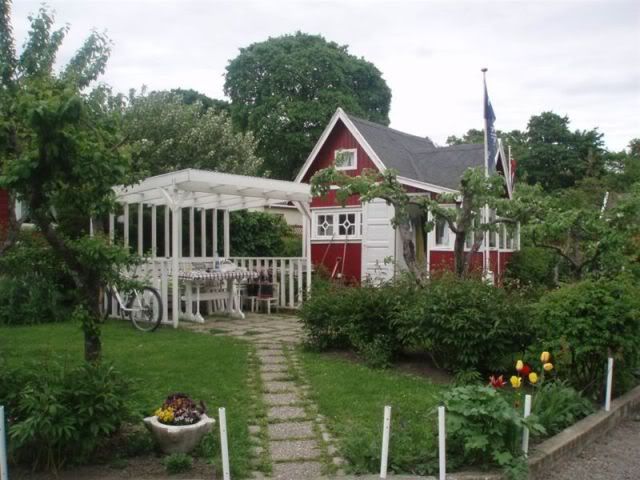 Since I moved not long ago, I haven’t been able to explore the kolonihage in my new neighbourhood yet. As I walked down the gravel lane with white picket fences on each side, I suddenly noticed a familiar pennant. It said “Portveien 2”.
 I went SQUEEEEE!
I realize this will not make sense to anyone that isn’t Norwegian, but let me try to translate it. Imagine you were walking around in your neighbourhood, and suddenly you found yourself strolling down Sesame Street. (Don’t tell me you didn’t go SQUEEEEE! now… )

I always knew they shot this show somewhere in Oslo, and I may have even known that it was in one of the kolonihage, but this sounded unlikely to me since I didn’t remember the house in the show as particularly small. In retrospect, I can think of two possible explanations to that: First of all, I was a lot smaller myself, so naturally the house looked bigger. Secondly, all houses looked small inside the TV… (Naturally, this was before the age of giant plasma screens)
Seeing the (slightly smaller than I remembered) house took me right back to my childhood. Suddenly I craved popsicles and my mother’s homemade pizza. I imagined waving my bare toes from the highest point of the swing set’s pendulum. Had I seen any, I would have picked wild strawberries and put them on a straw.
Walking through that kolonihage made me 20 years younger in a second. When I left, I was back at my own age, but with a smile on my face.
~~~~~~~~~~~~~~~
In other giraffe related news, I was thrilled to discover earlier this week that one of my giraffes (one that has made an appearance on this blog before) was chosen as "Giraffe of the day # 391" on http://www.onemilliongiraffes.com/. This project, which started as a silly bet, has earned originator and Giraffe in Command, Ola, 884,834 handmade giraffes since he started collecting a little over a year ago. The goal is to reach 1,000,000 before the end of this year, and it looks like Ola is going to win his bet. But there are still 115,166 giraffes missing - you go make one right now, and upload it to (I'll provide the link just one more time, shall I?) http://burrowers.blogspot.com/ - just kidding - to http://www.onemilliongiraffes.com/, of course :)
Have a very happy weekend, lovely followers! Don't forget to check in at the Burrow Blog. We have a special something planned for this weekend :)
Thursday, June 24, 2010
On Oslo
Washington, D.C. is more impressive. Paris is more chic. Tokyo is more modern. Berlin is more shopping friendly. But Oslo is home.
I have visited a number of great cities around the world, and many of them have left lasting impressions on me. But as far as I know Oslo is the only one of these cities where you can hop on the metro or a bus from anywhere in the vibrant city centre and within half an hour be deep in the forest or out on the fjord.
 Oslo is a small city by international standards, but it is Norway’s only proper metropolis. It doesn’t have enough people to make it crowded, but there is enough to uphold a decent quantity of theaters, concerts, exhibitions and other activities that depend on a certain amount of customers. As far as Norwegian standards go, Oslo is fairly diverse, and you can find small enclaves of different cultures around the city (but rather than Chinatown or Little Mexico, you have Little Little Pakistan). Oslo have both crazily expensive 12 bedroom mansions, apartment complexes originally built for working class heroes, and English style brick houses with surrounding gardens. The different areas of the city range from those who were settled in (and still have some original buildings from) the Viking Age, and those who are being constructed (or reconstructed) today.
 Of the latter is the new opera house rising from the water in Bjørvika. Once you tire of promenading on top of the smooth marble surface, you can go see the view over the city from the new ski jump at Holmenkollen, or you can go people watching by the seaside at Aker Brygge. You can sit in one of the parks along the river. You can explore medieval ruins in the Old Town, or climb the cannons at the fortress. If there is a rain shower (let’s face it, it’s Norway – there probably will be) you can go see an original Munch at the designated museum at Tøyen, or you can visit the Kon Tiki or maritime museums out on Bygdøy.
In my opinion Oslo is at its best in May or June. That is when you have the best chance of experiencing days like today, when all you want to do is stroll down in the park and read a book, or take the ferry out to one of the islands where you can bathe in the cool seawater of the fjord. It is sunny outside, but thanks to the Scandinavian climate and a slight breeze, it isn’t hot. It is perfectly comfortable to sit outside in the sunshine, sipping an iced tea at a local café (like I am doing right now). This is one of those days when Oslo feels like a bigger city than it really is, because so many people are outside. People are smiling at strangers for once. They are showing off white arms and legs, not yet touched by much sunlight this season. In a few hours they will be lightly tanned arms and legs, or, if you’re like me – light pink.
Oslo in June is what makes Oslo in January worth enduring.
Disclaimer #1: No, I am not paid by the Norwegian Tourist Agency or some such institution to write this. I really do feel this way about Oslo at times.
Diclaimer #2: To prove the above... I wrote this yesterday. Today we're back to "cloudy with a chance of Norwegian summer". Sigh.
I have visited a number of great cities around the world, and many of them have left lasting impressions on me. But as far as I know Oslo is the only one of these cities where you can hop on the metro or a bus from anywhere in the vibrant city centre and within half an hour be deep in the forest or out on the fjord.
 Oslo is a small city by international standards, but it is Norway’s only proper metropolis. It doesn’t have enough people to make it crowded, but there is enough to uphold a decent quantity of theaters, concerts, exhibitions and other activities that depend on a certain amount of customers. As far as Norwegian standards go, Oslo is fairly diverse, and you can find small enclaves of different cultures around the city (but rather than Chinatown or Little Mexico, you have Little Little Pakistan). Oslo have both crazily expensive 12 bedroom mansions, apartment complexes originally built for working class heroes, and English style brick houses with surrounding gardens. The different areas of the city range from those who were settled in (and still have some original buildings from) the Viking Age, and those who are being constructed (or reconstructed) today.
In my opinion Oslo is at its best in May or June. That is when you have the best chance of experiencing days like today, when all you want to do is stroll down in the park and read a book, or take the ferry out to one of the islands where you can bathe in the cool seawater of the fjord. It is sunny outside, but thanks to the Scandinavian climate and a slight breeze, it isn’t hot. It is perfectly comfortable to sit outside in the sunshine, sipping an iced tea at a local café (like I am doing right now). This is one of those days when Oslo feels like a bigger city than it really is, because so many people are outside. People are smiling at strangers for once. They are showing off white arms and legs, not yet touched by much sunlight this season. In a few hours they will be lightly tanned arms and legs, or, if you’re like me – light pink.
Oslo in June is what makes Oslo in January worth enduring.
Disclaimer #1: No, I am not paid by the Norwegian Tourist Agency or some such institution to write this. I really do feel this way about Oslo at times.
Diclaimer #2: To prove the above... I wrote this yesterday. Today we're back to "cloudy with a chance of Norwegian summer". Sigh.
Wednesday, April 14, 2010
On girafă*
I have earlier blogged about how Romanian accordion players have become something of a sign of spring in Oslo. They are everywhere. While my previous post focused on the charming element of this; there is a much more serious side of this story. This is the heart-wrenching part of it.
Most mornings I take the tram to the university. Oslo still has a number of street cars (in addition to the subway and buses) taking you across the (extended) city centre relatively efficiently. In my case, the tram ride takes longer than the subway, but it saves me from a more crowded commute and a longish walk in the morning when I usually am in a hurry. The tram also is crowded, but less so.
About a month or so ago I noticed a new trend on my morning tram ride. Three or four people unmistakably recognizable as Romanian accordion players and/or beggars were on the tram. Just like anyone else going to work, they were taking the tram. Only most people’s work doesn’t consist of standing outside (in still relatively cold weather) for twelve hours a day, hoping to earn a few coins from passing strangers.
The Romanians are easily recognized. The way they look and dress, for one thing, and the accordion many of them are carrying distinguishes them from most commuters. In addition I noticed one other thing on the tram – they carried the unmistakable smell of people who are living outdoors. These were human beings who hadn’t had the opportunity to take a shower or change their clothes for weeks. As I realized this, I pitied them, but there was nothing I could do about it, so it quickly escaped my mind when they left for work at their preferred locations downtown.
A few days later, however, I thought about them again when I read a news story in the paper. 41 Romanians had been evicted from a tiny apartment not far away from where I live, due to unsanitary conditions and for fire precaution reasons. The images from the apartment were disturbing to say the least. The mere idea that people had been living in what looked like a dump where food, garbage and excrements were floating, was shocking. The fact that they were so many in that tiny space, and that several of them had been seriously ill, made it all the worse. What perhaps made it especially close for me, however, was that the next morning, and every morning afterwards, the Romanians on the tram have been gone. It’s an easy conclusion to draw – the ones evicted were “my” Romanians.
I’m all for a liberal immigration policy. Partly because I realize that from a strictly economic perspective Norway is a country that without immigration would be in shortage of labour. From a socioeconomic perspective I also recognize the value the work and presence of these immigrants add to our society. Taking this into account, the challenge lies in having a solid integration policy, not in having a restricted immigration policy.
However, there are two problems with the current flow of people coming from Romania (and some other East European countries – but the Romanians make a reasonable example and a considerable portion of the group of people in question). First of all, they are not creating any values. They are not working, and thus they are not paying taxes. They are not buying anything here either, so from a strictly economic point of view, they are not adding to the creation of economic values. However, they are not creating any non-economic values either, seeing as they don’t intermingle with others.
Secondly, they are not immigrants. They have no intention of staying in Norway. They are here to make money, and the little money they make, they take back with them to Romania. What they are doing is taking economic values with them, and they are not making up for it by leaving anything (economic or otherwise) behind.
Even from a humanitarian point of view, however, I do not know if I think it is such a good idea for them to come here in a desperate search for money. I cannot even imagine what conditions they must be living under at home if they really see the alternative of living like animals crowded together in a foreign country is a price worth paying.
I got into a discussion a while back with a couple of friends. We all agreed that the situation for the Romanians in Oslo is awful and intolerable. We were not able to come up with an easy solution, though. My friends all argued that they felt terrible every time they passed one of the beggars without giving them anything. Personally, I have quite a firm principle when it comes to beggars. I almost never give anything, both because I rarely carry cash, but more importantly because I know that there are alternative ways for them to earn an income in Norway. No one has to beg on the streets here, and if they do, it’s often because they do not want to succumb to the institutions available. Obviously, this image is not always as black-white as I claim here, but that is the basic situation.
With the Romanians, however, the circumstances are completely different. They are not Norwegian citizens, and thus they don’t qualify for these institutions. And yet the Norwegian beggar who is openly going to use the money he receives on drugs, gets more than the obviously poor Romanian women holding their cups up to passers-by.
I still do not believe giving them my spare change will make any lasting difference. To me, it seems apparent that what needs to be changed is the system. Ideally, the system that should be changed is the one that is clearly not functioning well back in Romania. They should not have to come here and live under such inhuman conditions. As my friends pointed out, however, there isn’t much hope for a system change in Romania. So for us to wish that the Romanians leave and hope for the best back home, is not really a viable solution.
Apart from the guilty conscience they give us – are the Romanians really a problem here? Are they an actual burden to our admittedly well-fed society, or can we allow ourselves to let them stay if they believe this life is better than the one they were leading where they came from?
This is a difficult question. Many of them probably do no harm at all. I stand by my basic view that no one should have to live like this in Norway in 2010, but if they perceive themselves as better off here, who am I to judge? Well, there is an added problem that probably does not apply to all of them, but certainly to some. There have been raids of muggings and thefts that have been associated with the accordion players and the beggars. It appears that they operate in groups, where some of them are performing legit or semi-legit activities (it is technically legal to beg in Norway since the abolishment of the løsgjengerloven [“the drifter bill”, roughly translated] in 2006), while others are doing definite illegal ones. As it stands, it appears they have nothing to lose. If they avoid getting caught, they can return to their country with whatever values they have gained. If they are getting caught, they are put into Norwegian prisons, which, frankly, probably are far better than whatever lodging they have so far had in Norway.
As far as I can tell, there are indications but no firm evidence that the Romanians are organized – that the beggars and accordion players are working together with criminals who are raiding stores and private homes. Fortunately, one right that still applies to the Romanians (because it is a universal human right rather than one depending on the colour of your passport) is innocence until the opposite is proven.
Whether or not they are organized, however, (as another one of my friends pointed out) – they still need our help. Regardless of this, the partly documented and highly speculative indication that Romanians and other similar groups are responsible for a large share of crime in Oslo and Norway in general triggers xenophobia. Obviously, not all of the beggars and accordion players are criminals. But it is difficult if not impossible for the average Norwegian to distinguish the criminals from the rest, and this further diminishes the Romanians’ chances of succeeding with their legal efforts here.
In a way, the different attitudes towards the Romanians remind me of Victor Hugo’s famed Les Misérables. On the one hand, you have those who want to help no matter what – like the bishop who gives Jean Valjean food and shelter, and then dons Valjean two silver chandeliers stolen from the bishop as a way of getting Valjean out of trouble. On the other hand, you have the Javerts. The crazed police officer does everything possible to hunt down what he believes is a criminal. Neither the bishop or Javert takes the whole situation into account. Javert refuses to acknowledge that Valjean’s only crime was to steal because he wanted to feed a starving child. The bishop chooses to ignore Valjean’s criminal streak because he believes in the good within every human. While I would much rather be the bishop than Javert, I feel there is a middle road lacking. Someone who does recognize the fact that Valjean is a criminal (not so much for his original sin, but for the one he commits when stealing the chandeliers from his benefactor), but at the same time keeps in mind what caused him to commit the crime. And to me, the end result should be, rather than helping the individual and hope for the best (because sadly, not everyone would do like Valjean and turn his life around because of one act of kindness), removal of the cause of the collective problem. Valjean shouldn’t have been put in a position where he was forced to steal in the first place. The Romanians in Norway should not have to beg or steal or even play the accordion. They should have jobs, and some genuine prospects.
In the meantime there are now at least 41 Romanians who no longer have a home, but who nevertheless probably still live somewhere in Oslo, hoping to earn those few kroner each day so that they might have a slightly better life when they return home come autumn. It is heartbreakingly sad, but I really do not know what can be done.
~~~~~~~~~~~~~~~~~~
* Girafă means giraffe (no surprises there) in Romanian. Romanian being a romance language (”romance” as in the language category, not as in ”Lady and the Tramp meatball puffing”) isn’t a language I normally would have chosen to title a giraffy blog (since languages within the same linguistic group often have similar sounding words for obsolete things such as giraffes, and this normally wouldn't have been exotic enough for me to chose). However, with the topic of the blog it seemed to fit. Sadly.
It might have been more appropriate for this post to use the Romani word for giraffe instead of the Romanian one. In Norway the media almost consequently uses the term “Romanians” to denominate the people I have spoken of in this post, and I have chosen to do so too. Even though many of them are Romanian citizens, they are Romani people, gypsies (or so I have been told). While certain people in Norway have used this as an excuse to distinguish this group from other Romanians, in reality this is just another way of discriminating gypsies. The relevance of making this distinction, however, could be that we know gypsies are already shunned many places, and it makes the argument that they are not living good lives elsewhere more valid. But apart from that, I don’t see the relevance of distinguishing them from other Romanians, so I have avoided doing so.
However, Wikipedia failed to teach me what a gypsy would call a giraffe. I could not find a Romani page for giraffe (which has been my way of finding exotic giraffe names). Whether this means that the Romani aren’t all that into giraffes or if it has some other explanation, I cannot say.
Also, this post has taken me a looooong time to write (and it is looooong as well – sorry about that). It is a touchy topic, with a number of potential traps to fall into. I didn’t wish to offend anyone, so I weighed each word carefully. I didn’t wish to simplify the problem, so I have read countless newspaper articles, public police reports, and other research material that I was able to get a hold of. Most of all, I did wish to do justice to this subject, paticularly because I feel a lack of justice this has often been part of the problem. Regardless of what the Romanians in Oslo has or has not done, they are still human beings, but they are not treated as such. It breaks my heart to see this happening, every day, in a country that supposedly is the world’s best place to live.
Most mornings I take the tram to the university. Oslo still has a number of street cars (in addition to the subway and buses) taking you across the (extended) city centre relatively efficiently. In my case, the tram ride takes longer than the subway, but it saves me from a more crowded commute and a longish walk in the morning when I usually am in a hurry. The tram also is crowded, but less so.
About a month or so ago I noticed a new trend on my morning tram ride. Three or four people unmistakably recognizable as Romanian accordion players and/or beggars were on the tram. Just like anyone else going to work, they were taking the tram. Only most people’s work doesn’t consist of standing outside (in still relatively cold weather) for twelve hours a day, hoping to earn a few coins from passing strangers.
The Romanians are easily recognized. The way they look and dress, for one thing, and the accordion many of them are carrying distinguishes them from most commuters. In addition I noticed one other thing on the tram – they carried the unmistakable smell of people who are living outdoors. These were human beings who hadn’t had the opportunity to take a shower or change their clothes for weeks. As I realized this, I pitied them, but there was nothing I could do about it, so it quickly escaped my mind when they left for work at their preferred locations downtown.
A few days later, however, I thought about them again when I read a news story in the paper. 41 Romanians had been evicted from a tiny apartment not far away from where I live, due to unsanitary conditions and for fire precaution reasons. The images from the apartment were disturbing to say the least. The mere idea that people had been living in what looked like a dump where food, garbage and excrements were floating, was shocking. The fact that they were so many in that tiny space, and that several of them had been seriously ill, made it all the worse. What perhaps made it especially close for me, however, was that the next morning, and every morning afterwards, the Romanians on the tram have been gone. It’s an easy conclusion to draw – the ones evicted were “my” Romanians.
I’m all for a liberal immigration policy. Partly because I realize that from a strictly economic perspective Norway is a country that without immigration would be in shortage of labour. From a socioeconomic perspective I also recognize the value the work and presence of these immigrants add to our society. Taking this into account, the challenge lies in having a solid integration policy, not in having a restricted immigration policy.
However, there are two problems with the current flow of people coming from Romania (and some other East European countries – but the Romanians make a reasonable example and a considerable portion of the group of people in question). First of all, they are not creating any values. They are not working, and thus they are not paying taxes. They are not buying anything here either, so from a strictly economic point of view, they are not adding to the creation of economic values. However, they are not creating any non-economic values either, seeing as they don’t intermingle with others.
Secondly, they are not immigrants. They have no intention of staying in Norway. They are here to make money, and the little money they make, they take back with them to Romania. What they are doing is taking economic values with them, and they are not making up for it by leaving anything (economic or otherwise) behind.
Even from a humanitarian point of view, however, I do not know if I think it is such a good idea for them to come here in a desperate search for money. I cannot even imagine what conditions they must be living under at home if they really see the alternative of living like animals crowded together in a foreign country is a price worth paying.
I got into a discussion a while back with a couple of friends. We all agreed that the situation for the Romanians in Oslo is awful and intolerable. We were not able to come up with an easy solution, though. My friends all argued that they felt terrible every time they passed one of the beggars without giving them anything. Personally, I have quite a firm principle when it comes to beggars. I almost never give anything, both because I rarely carry cash, but more importantly because I know that there are alternative ways for them to earn an income in Norway. No one has to beg on the streets here, and if they do, it’s often because they do not want to succumb to the institutions available. Obviously, this image is not always as black-white as I claim here, but that is the basic situation.
With the Romanians, however, the circumstances are completely different. They are not Norwegian citizens, and thus they don’t qualify for these institutions. And yet the Norwegian beggar who is openly going to use the money he receives on drugs, gets more than the obviously poor Romanian women holding their cups up to passers-by.
I still do not believe giving them my spare change will make any lasting difference. To me, it seems apparent that what needs to be changed is the system. Ideally, the system that should be changed is the one that is clearly not functioning well back in Romania. They should not have to come here and live under such inhuman conditions. As my friends pointed out, however, there isn’t much hope for a system change in Romania. So for us to wish that the Romanians leave and hope for the best back home, is not really a viable solution.
Apart from the guilty conscience they give us – are the Romanians really a problem here? Are they an actual burden to our admittedly well-fed society, or can we allow ourselves to let them stay if they believe this life is better than the one they were leading where they came from?
This is a difficult question. Many of them probably do no harm at all. I stand by my basic view that no one should have to live like this in Norway in 2010, but if they perceive themselves as better off here, who am I to judge? Well, there is an added problem that probably does not apply to all of them, but certainly to some. There have been raids of muggings and thefts that have been associated with the accordion players and the beggars. It appears that they operate in groups, where some of them are performing legit or semi-legit activities (it is technically legal to beg in Norway since the abolishment of the løsgjengerloven [“the drifter bill”, roughly translated] in 2006), while others are doing definite illegal ones. As it stands, it appears they have nothing to lose. If they avoid getting caught, they can return to their country with whatever values they have gained. If they are getting caught, they are put into Norwegian prisons, which, frankly, probably are far better than whatever lodging they have so far had in Norway.
As far as I can tell, there are indications but no firm evidence that the Romanians are organized – that the beggars and accordion players are working together with criminals who are raiding stores and private homes. Fortunately, one right that still applies to the Romanians (because it is a universal human right rather than one depending on the colour of your passport) is innocence until the opposite is proven.
Whether or not they are organized, however, (as another one of my friends pointed out) – they still need our help. Regardless of this, the partly documented and highly speculative indication that Romanians and other similar groups are responsible for a large share of crime in Oslo and Norway in general triggers xenophobia. Obviously, not all of the beggars and accordion players are criminals. But it is difficult if not impossible for the average Norwegian to distinguish the criminals from the rest, and this further diminishes the Romanians’ chances of succeeding with their legal efforts here.
In a way, the different attitudes towards the Romanians remind me of Victor Hugo’s famed Les Misérables. On the one hand, you have those who want to help no matter what – like the bishop who gives Jean Valjean food and shelter, and then dons Valjean two silver chandeliers stolen from the bishop as a way of getting Valjean out of trouble. On the other hand, you have the Javerts. The crazed police officer does everything possible to hunt down what he believes is a criminal. Neither the bishop or Javert takes the whole situation into account. Javert refuses to acknowledge that Valjean’s only crime was to steal because he wanted to feed a starving child. The bishop chooses to ignore Valjean’s criminal streak because he believes in the good within every human. While I would much rather be the bishop than Javert, I feel there is a middle road lacking. Someone who does recognize the fact that Valjean is a criminal (not so much for his original sin, but for the one he commits when stealing the chandeliers from his benefactor), but at the same time keeps in mind what caused him to commit the crime. And to me, the end result should be, rather than helping the individual and hope for the best (because sadly, not everyone would do like Valjean and turn his life around because of one act of kindness), removal of the cause of the collective problem. Valjean shouldn’t have been put in a position where he was forced to steal in the first place. The Romanians in Norway should not have to beg or steal or even play the accordion. They should have jobs, and some genuine prospects.
In the meantime there are now at least 41 Romanians who no longer have a home, but who nevertheless probably still live somewhere in Oslo, hoping to earn those few kroner each day so that they might have a slightly better life when they return home come autumn. It is heartbreakingly sad, but I really do not know what can be done.
~~~~~~~~~~~~~~~~~~
* Girafă means giraffe (no surprises there) in Romanian. Romanian being a romance language (”romance” as in the language category, not as in ”Lady and the Tramp meatball puffing”) isn’t a language I normally would have chosen to title a giraffy blog (since languages within the same linguistic group often have similar sounding words for obsolete things such as giraffes, and this normally wouldn't have been exotic enough for me to chose). However, with the topic of the blog it seemed to fit. Sadly.
It might have been more appropriate for this post to use the Romani word for giraffe instead of the Romanian one. In Norway the media almost consequently uses the term “Romanians” to denominate the people I have spoken of in this post, and I have chosen to do so too. Even though many of them are Romanian citizens, they are Romani people, gypsies (or so I have been told). While certain people in Norway have used this as an excuse to distinguish this group from other Romanians, in reality this is just another way of discriminating gypsies. The relevance of making this distinction, however, could be that we know gypsies are already shunned many places, and it makes the argument that they are not living good lives elsewhere more valid. But apart from that, I don’t see the relevance of distinguishing them from other Romanians, so I have avoided doing so.
However, Wikipedia failed to teach me what a gypsy would call a giraffe. I could not find a Romani page for giraffe (which has been my way of finding exotic giraffe names). Whether this means that the Romani aren’t all that into giraffes or if it has some other explanation, I cannot say.
Also, this post has taken me a looooong time to write (and it is looooong as well – sorry about that). It is a touchy topic, with a number of potential traps to fall into. I didn’t wish to offend anyone, so I weighed each word carefully. I didn’t wish to simplify the problem, so I have read countless newspaper articles, public police reports, and other research material that I was able to get a hold of. Most of all, I did wish to do justice to this subject, paticularly because I feel a lack of justice this has often been part of the problem. Regardless of what the Romanians in Oslo has or has not done, they are still human beings, but they are not treated as such. It breaks my heart to see this happening, every day, in a country that supposedly is the world’s best place to live.
Monday, April 12, 2010
On Sunday the 11th of April
I almost never do a “this is what I did today” blog. Partly because I almost never write my posts on the day I publish them. I usually let them simmer for a while, and I like to get a second or third read-through with fresh eyes which can only be achieved if I write it first, then leave it for a while, and then read it again. This gives me the ability to spot terrible writing, and the strength to cut it like a mad butcher. (Take this paragraph. Absolutely hopeless. I expect to molest it to smithereens before finally being satisfied with it [unless I will keep it the way it currently is to make a point. Oh, dang, now that I said it, I kind of have to, don’t I?].)
The other reason I don’t do “this is what I did today” posts is because I have absolutely no need for this blog to turn into my personal (yet very public) diary. I used to keep diaries (well, one at the time…). When I visited my parents over the Easter break, I found some of my old diaries, and boy am I glad those aren’t public material... Some of it probably should be – if it’s true that laughter is healthy, I should be sentenced for keeping this miracle drug to myself.
Back when I kept a diary I was surprisingly audience-aware (even if I pointed out a number of times that the only audience for whom I was writing was myself). I was concerned with voice, language, structure – all the things I now consider when composing texts were already then tools I actively used (more or less consciously) to make a readable diary.
A third reason I normally avoid “this is what I did today” (if I am going to continue using this term I very soon need to invent an abbreviation for it – TIWIDT?) posts is that my life often isn’t all that exciting on a day-to-day basis. A lot of my blog posts would sound something like this: “I got up between 6 am and 7.30 am (entirely depending on how long I bothered hitting the snooze button before actually leaving bed – usually somewhere between 3 and 50 times. No kidding). Had a shower, took the tram to the university. Sat at my desk for X hours, only interrupted by Y number of breaks. Took the tram back home. Slept.” Boring!
Today, however, has been an out of the ordinary sort of day. So if I ever was to do a TIWIDT post, this would be the time.
Oslo seems to be the kind of city where it’s either awesome or awful to be. It’s never, or at least rarely, “just okay”. Today was one of the awesome days. The sun was shining, and believe you me, after five months of winter and one month of rain (slightly exaggerated on both accounts, but not by a lot) we deserve some sun. When it finally showed up, however, it was so brilliant that it hardly feels like it’s been gone at all. I think my face freckled up after about ten minutes outside (alright – I’m exaggerating again – first of all we had lots of sun yesterday as well, and secondly I spent about 7 hours outside today, so I was expecting spring freckles).
I’m not the only one who feels this way. It takes no more than ten degrees (celcius) and half an hour of sun before Osloensians (we aren’t called that. I don’t really know what we are called. So I made up a name. I do that a lot…) are popping up everywhere, smiling, wearing short sleeves, eating ice cream or drinking beer (utepils – "outdoors beer" – is a common term here). If I had told a foreigner walking around in Oslo two weeks ago that the city has half a million inhabitants he wouldn’t have believed it, because there were no one to be seen. If I had told him today, he might be inclined to think I was making an understatement. Oslo does have half a million inhabitants, and today all of them were outside (or so it seemed).
I too acted like a proper Osloensian (it’s catching on!) today and enjoyed just how lovely this city can be in springtime. My roommate and I walked to a museum I’ve been meaning to visit for a while. The Nobel Peace Center (whose giraffe mascot I wrote a blog post about a while back) has been featuring an exhibit called “From King to Obama”, showing the links between the two Nobel Peace Prize laureates (cleverly summed up in the following quote: “Rosa sat so Martin could walk. Martin walked so Barack could run. Barack ran so our children can fly.”). As the quote perhaps also shows, the exhibit somewhat glorified both King and Obama. However, since the exhibit was focusing on the Nobel Peace Prize aspect of both their journeys I suppose there was little point in emphasizing any controversies.
After the exhibit (and the gift shop. Let’s not forget the gift shop. I almost always prefer the gift show [shop. I might subconsciously have given the answer to why I always prefer the gift shop. Clearly I mistake it for a show!] to the actual museum no matter how interesting the exhibits…) we had lunch – outside, naturally (this is also part of the Oslo spring – every little café will magically conjure up at least one table with a couple of chairs, and voila – people can enjoy their coffee/beer/meal/ice cream at the risk of freezing to death. Very charming). There we also met another friend of mine, before both my friends left me to walk around on my own. I went to the fortress, where I took some very poor pictures (in my defense, I was blinded by the sun), before a friend called up asking if I wanted ice cream. Of course I did.
I had some spare time before the ice cream appointment, so I went to a bookshop (probably the only one in Oslo that is open on a Sunday) to see if I could find a copy of The Secret Garden. This little piece of information has so many digressions tied to it that even I don’t know where to start… Alright, let’s give it a try.
First of all, I always, always read The Secret Garden in spring, and I have for as long as I’ve been able to read. It’s very important that I don’t read it too early (if any more snow falls after I’ve started reading it, spring is ruined), but I can also not read it too late (it’s already late-ish. Anything after April is out of the question). While I recognize that there are books that are better written, more interesting, with better plots and more complex characters; I still considers this as my favourite book. After all, I have read it about 20 times by now.
Seeing as I love it so much, you might wonder why I haven’t purchased it before. Oh, I have! Trust me! I own no less than three copies of this book. The first one is in Norwegian, and this is the copy I have read over and over and over and… And over. I know every little typo (there are plenty) in that copy, and because this is my childhood copy, I must admit I prefer it. For every other book, though, I tend to prefer the original version (that is, if the original version is in a language I can read. So my “original version preference” is pretty much limited to English and Norwegian. And Swedish and Danish, but that is only because they are so similar to Norwegian. It also used to include French, but I haven’t tried reading French for years, so I don’t know how much I’d get out of it now. How stupid was I to let my third language go?!?).
Since I normally prefer the original version, I decided to convert to English for my annual Secret Garden reading a couple of years ago. I bought it in English, and started reading it, but it just wasn’t the same… What I didn’t know, however, was that a good friend of mine (who was at the time living in the US) had bought me another English version, a beautifully illustrated version, even. When she came back with this thoughtful gift for me, I didn’t have the heart to tell her that a) I had already bought a copy; and b) I preferred reading it in Norwegian. So I accepted the present. The following spring (last spring, in fact) when I had to pack most of my books away for long-time storage since I was moving, I chose to keep the illustrated English version in the easy access pile, while the two others went into boxes.
Thus, I only had one of my three copies available this spring. I had completely forgotten that I had packed the other two copies when I promised my sister that she could borrow the book from me this spring. Consequently, I lent her my only remaining copy, and was left with nothing… I didn’t have the heart to tell her that I didn’t have another copy, but I also could not face having spring ruined because I could not read it. So I thought that buying another copy was a reasonable solution (I will never be rich. Not as long as there are bookshops in the world). (Un?)Fortunately, my other sister called just as I was about to make the purchase, and she managed to convince me to check a library before buying it (again). So, I still don’t have the book, but I’m guessing that this time tomorrow I will (if the library at the university doesn’t have it, the bookshop probably will. And what are the odds that my sister phones me twice in two days?).
To finish this digression before returning to the actual topic – as far as I know neither my sister nor my friend are regular readers of this blog, so I feel relatively safe writing about this without making anyone feel too bad about the possible ruination of my spring…
(See, this is another reason why I don’t write TIWIDT posts. With my digressionary tendencies, they end up frightfully long! I shall try to hasten my pace…)
I eventually met up with my friends for ice cream. Again, we insisted on sitting outside, even though it was getting chillier by then. Eating ice cream in Oslo in April in sunshine (am I even allowed to have that many in’s in [haha] one sentence?) can be quite pleasant. Eating ice cream in April in Oslo in shade, however, is c-c-cold. But we survived, and afterwards we strolled around to regain normal body temperatures. Oslo (this post should of course be called “On Oslo” [or quite possibly “On The Secret Garden”], but I have reserved that title [the Oslo-one] for a similar-yet-different post that I have in mind for June[-ish]) – Oslo has a relatively new opera house, and it has become a popular attraction for tourists and Osloensians alike. You can walk around on its white marble exterior, looking out over the fjord. It’s very nice, actually. We went there for something of a photo shoot (don’t ask – I have digressed enough as it is), before I finally decided it was time to call it a day.
I made one last stop on my way home – I picked some flowers that to me more than anything say spring. Hestehov [tussilago farfara, or coltsfoot] isn’t actually all that pretty. It doesn’t smell nice, and it grows in such numbers that by many it is considered a weed. Still, it is the first wild flower that appears each spring, and the yellow little heads look like miniature suns stretching towards the sky. In true spirit of this springful day, then, I picked some and brought home where they are now sunning up our kitchen table (I just googled “sunning” to make sure I wasn’t saying something I didn’t know what meant. The definition “the opposite of mooning – involving front” clearly implies that I did… And yet, I am too tired and amused to change it…).
There. I finished my TIWIDT post. I shall post it as it is (with one quick read-though. Just the one), even if it is as long as a Osloensian winter. Now that I think about it, though, the proper title of this post would have been “On spring”. Oh, well…
[Note: if you have actually read through all of the above you also deserve to know that I really meant to post this last night. Just as I typed up the last paragraph, however, my internet connection died. I probably should have interpreted this as a sign that the Internet gods didn't want me to expose anyone to such a lenghty ramble. Seeing as you are reading this, I evidently am not afraid of the wrath of the Internet gods. If you never hear from me again, chances are I should have been afraid...]
The other reason I don’t do “this is what I did today” posts is because I have absolutely no need for this blog to turn into my personal (yet very public) diary. I used to keep diaries (well, one at the time…). When I visited my parents over the Easter break, I found some of my old diaries, and boy am I glad those aren’t public material... Some of it probably should be – if it’s true that laughter is healthy, I should be sentenced for keeping this miracle drug to myself.
Back when I kept a diary I was surprisingly audience-aware (even if I pointed out a number of times that the only audience for whom I was writing was myself). I was concerned with voice, language, structure – all the things I now consider when composing texts were already then tools I actively used (more or less consciously) to make a readable diary.
A third reason I normally avoid “this is what I did today” (if I am going to continue using this term I very soon need to invent an abbreviation for it – TIWIDT?) posts is that my life often isn’t all that exciting on a day-to-day basis. A lot of my blog posts would sound something like this: “I got up between 6 am and 7.30 am (entirely depending on how long I bothered hitting the snooze button before actually leaving bed – usually somewhere between 3 and 50 times. No kidding). Had a shower, took the tram to the university. Sat at my desk for X hours, only interrupted by Y number of breaks. Took the tram back home. Slept.” Boring!
Today, however, has been an out of the ordinary sort of day. So if I ever was to do a TIWIDT post, this would be the time.
Oslo seems to be the kind of city where it’s either awesome or awful to be. It’s never, or at least rarely, “just okay”. Today was one of the awesome days. The sun was shining, and believe you me, after five months of winter and one month of rain (slightly exaggerated on both accounts, but not by a lot) we deserve some sun. When it finally showed up, however, it was so brilliant that it hardly feels like it’s been gone at all. I think my face freckled up after about ten minutes outside (alright – I’m exaggerating again – first of all we had lots of sun yesterday as well, and secondly I spent about 7 hours outside today, so I was expecting spring freckles).
I’m not the only one who feels this way. It takes no more than ten degrees (celcius) and half an hour of sun before Osloensians (we aren’t called that. I don’t really know what we are called. So I made up a name. I do that a lot…) are popping up everywhere, smiling, wearing short sleeves, eating ice cream or drinking beer (utepils – "outdoors beer" – is a common term here). If I had told a foreigner walking around in Oslo two weeks ago that the city has half a million inhabitants he wouldn’t have believed it, because there were no one to be seen. If I had told him today, he might be inclined to think I was making an understatement. Oslo does have half a million inhabitants, and today all of them were outside (or so it seemed).
I too acted like a proper Osloensian (it’s catching on!) today and enjoyed just how lovely this city can be in springtime. My roommate and I walked to a museum I’ve been meaning to visit for a while. The Nobel Peace Center (whose giraffe mascot I wrote a blog post about a while back) has been featuring an exhibit called “From King to Obama”, showing the links between the two Nobel Peace Prize laureates (cleverly summed up in the following quote: “Rosa sat so Martin could walk. Martin walked so Barack could run. Barack ran so our children can fly.”). As the quote perhaps also shows, the exhibit somewhat glorified both King and Obama. However, since the exhibit was focusing on the Nobel Peace Prize aspect of both their journeys I suppose there was little point in emphasizing any controversies.
After the exhibit (and the gift shop. Let’s not forget the gift shop. I almost always prefer the gift show [shop. I might subconsciously have given the answer to why I always prefer the gift shop. Clearly I mistake it for a show!] to the actual museum no matter how interesting the exhibits…) we had lunch – outside, naturally (this is also part of the Oslo spring – every little café will magically conjure up at least one table with a couple of chairs, and voila – people can enjoy their coffee/beer/meal/ice cream at the risk of freezing to death. Very charming). There we also met another friend of mine, before both my friends left me to walk around on my own. I went to the fortress, where I took some very poor pictures (in my defense, I was blinded by the sun), before a friend called up asking if I wanted ice cream. Of course I did.
I had some spare time before the ice cream appointment, so I went to a bookshop (probably the only one in Oslo that is open on a Sunday) to see if I could find a copy of The Secret Garden. This little piece of information has so many digressions tied to it that even I don’t know where to start… Alright, let’s give it a try.
First of all, I always, always read The Secret Garden in spring, and I have for as long as I’ve been able to read. It’s very important that I don’t read it too early (if any more snow falls after I’ve started reading it, spring is ruined), but I can also not read it too late (it’s already late-ish. Anything after April is out of the question). While I recognize that there are books that are better written, more interesting, with better plots and more complex characters; I still considers this as my favourite book. After all, I have read it about 20 times by now.
Seeing as I love it so much, you might wonder why I haven’t purchased it before. Oh, I have! Trust me! I own no less than three copies of this book. The first one is in Norwegian, and this is the copy I have read over and over and over and… And over. I know every little typo (there are plenty) in that copy, and because this is my childhood copy, I must admit I prefer it. For every other book, though, I tend to prefer the original version (that is, if the original version is in a language I can read. So my “original version preference” is pretty much limited to English and Norwegian. And Swedish and Danish, but that is only because they are so similar to Norwegian. It also used to include French, but I haven’t tried reading French for years, so I don’t know how much I’d get out of it now. How stupid was I to let my third language go?!?).
Since I normally prefer the original version, I decided to convert to English for my annual Secret Garden reading a couple of years ago. I bought it in English, and started reading it, but it just wasn’t the same… What I didn’t know, however, was that a good friend of mine (who was at the time living in the US) had bought me another English version, a beautifully illustrated version, even. When she came back with this thoughtful gift for me, I didn’t have the heart to tell her that a) I had already bought a copy; and b) I preferred reading it in Norwegian. So I accepted the present. The following spring (last spring, in fact) when I had to pack most of my books away for long-time storage since I was moving, I chose to keep the illustrated English version in the easy access pile, while the two others went into boxes.
Thus, I only had one of my three copies available this spring. I had completely forgotten that I had packed the other two copies when I promised my sister that she could borrow the book from me this spring. Consequently, I lent her my only remaining copy, and was left with nothing… I didn’t have the heart to tell her that I didn’t have another copy, but I also could not face having spring ruined because I could not read it. So I thought that buying another copy was a reasonable solution (I will never be rich. Not as long as there are bookshops in the world). (Un?)Fortunately, my other sister called just as I was about to make the purchase, and she managed to convince me to check a library before buying it (again). So, I still don’t have the book, but I’m guessing that this time tomorrow I will (if the library at the university doesn’t have it, the bookshop probably will. And what are the odds that my sister phones me twice in two days?).
To finish this digression before returning to the actual topic – as far as I know neither my sister nor my friend are regular readers of this blog, so I feel relatively safe writing about this without making anyone feel too bad about the possible ruination of my spring…
(See, this is another reason why I don’t write TIWIDT posts. With my digressionary tendencies, they end up frightfully long! I shall try to hasten my pace…)
I eventually met up with my friends for ice cream. Again, we insisted on sitting outside, even though it was getting chillier by then. Eating ice cream in Oslo in April in sunshine (am I even allowed to have that many in’s in [haha] one sentence?) can be quite pleasant. Eating ice cream in April in Oslo in shade, however, is c-c-cold. But we survived, and afterwards we strolled around to regain normal body temperatures. Oslo (this post should of course be called “On Oslo” [or quite possibly “On The Secret Garden”], but I have reserved that title [the Oslo-one] for a similar-yet-different post that I have in mind for June[-ish]) – Oslo has a relatively new opera house, and it has become a popular attraction for tourists and Osloensians alike. You can walk around on its white marble exterior, looking out over the fjord. It’s very nice, actually. We went there for something of a photo shoot (don’t ask – I have digressed enough as it is), before I finally decided it was time to call it a day.
I made one last stop on my way home – I picked some flowers that to me more than anything say spring. Hestehov [tussilago farfara, or coltsfoot] isn’t actually all that pretty. It doesn’t smell nice, and it grows in such numbers that by many it is considered a weed. Still, it is the first wild flower that appears each spring, and the yellow little heads look like miniature suns stretching towards the sky. In true spirit of this springful day, then, I picked some and brought home where they are now sunning up our kitchen table (I just googled “sunning” to make sure I wasn’t saying something I didn’t know what meant. The definition “the opposite of mooning – involving front” clearly implies that I did… And yet, I am too tired and amused to change it…).
There. I finished my TIWIDT post. I shall post it as it is (with one quick read-though. Just the one), even if it is as long as a Osloensian winter. Now that I think about it, though, the proper title of this post would have been “On spring”. Oh, well…
[Note: if you have actually read through all of the above you also deserve to know that I really meant to post this last night. Just as I typed up the last paragraph, however, my internet connection died. I probably should have interpreted this as a sign that the Internet gods didn't want me to expose anyone to such a lenghty ramble. Seeing as you are reading this, I evidently am not afraid of the wrath of the Internet gods. If you never hear from me again, chances are I should have been afraid...]
Tuesday, March 16, 2010
On literary wars
You may remember my book circle. I mentioned it briefly in my crazed Friday post – as I am self-appointed resident baker for our meetings. My book circle had an extraordinary meeting, seeing as we were participating in a survey/interview for the National Broadcasting Company (NRK). They were asking for book circles where the members were under the age of 40, and we volunteered. There was a lot of commotion prior to this meeting, because we struggled a lot in finding a time where both we and the interviewers were able to participate, but finally, on Friday, we managed to get together.
It was an interesting event, seeing as we were able to talk quite liberally about the book coverage in NRK in general; about their website specifically (this was originally what we were supposed to review); and about anything else that came to our mind concerning NRK, a national institution we all grew up with.
Even though we spent even less time than usual to discuss the book of the month – Alice in Wonderland (no, we did not pick this one because the movie is just out... Fine, that is why…) – we decided to find a new book for our next (this time NRK-free) meeting.
We ended up weighing H.G. Wells’ The War of the Worlds (not The World of the Wars, as I keep calling it) against Joseph Heller’s Catch 22. Several of us favoured Heller – mostly because catch 22 has become an idiom, so we’d all like to know what the back story is. Perhaps even more mostly, though, we favoured Catch 22 because we, with one (or possibly two) exceptions, are generally skeptical towards science fiction (one might wonder what Wells is doing on the list at all, actually…). Another strong argument was that Tom Cruise is in Warp of the Worlds, but seeing as we’re supposed to read the book and not see the movie, this was quickly written off as irrelevant. However, we realized that since about half of our book circle members are finishing their master’s degrees this spring, we didn’t want a long book. So Wells’ hundred-something pages won over Heller’s five hundred-something.
As a result of our “intellectually” preferred book of the month, I went on another insidious book hunt this Saturday. Well, insidious might be overstretching things (I really like that word), but it was arduous at least. An onerous quest, that required a strenuous effort (yes, I am done flashing fancy words now).
The first bookshop I entered had a copy of The Warf of the Worlds. Yay! I almost bought it, but then I discovered that they also had a copy of Joseph Conrad’s Heart of Darkness (am I the only one who gets Joseph Conrad mixed up with Joseph Heller? Ironic, I know. At least it isn’t Lauren Conrad.). I’ve been in a funny reading mode lately, where I get extreme urges to read something from or depicting a specific country or culture. For instance, in the making of yesterday’s post, I immediately desired to read a book from the Central African Republic. I think it all started with my reading of Chris Cleave’s The Other Hand (otherwise known as “The Orange Book”) last year – at least this is the origin of my Africa-specific reading appetite. Anyway, I have for a while wanted to read something from the Congo. I’ve just started The Poisonwood Bible, and so far I really like it, but the book you’re “supposed” to read when the words “novel” and “the Congo” is mentioned in the same sentence is Heart of Darkness.
Consequently, I’ve been looking for this book for a while, and seeing it in the same shop that had the other book I was looking for, I figured this was probably the world’s way of telling me that I deserved both books (having just received my student loan also helped me conclude in this fashion).
However, my rationality kicked in. What might have been the true rational thing would have been to go to the library. But no, I’m not that rational. What I knew, though, is that there is another bookstore chain which has a running offer of 3 for 2 on English pocket books. Here I was about to buy two book in a different store, where I could get a third for free. No, siree!
There is a store of this same chain in the mall I was currently visiting, so I went there.
Naturally, they did not have The Wart of the Worlds. They did, however, have Heart of Darkness. When it comes to books, though, I don’t give up easily. There are a number of bookstores downtown Oslo, and the biggest one from the chain I wanted to visit, is right by the main street. It isn’t far to walk, but seeing as I somehow ended up visiting every other store in the area as well, it took some time to get there. In the process I even managed to buy a ridiculously expensive (and ridiculously purple) raincoat. I ♥ it!
When I finally got to the bookstore in question, I immediately went to the classics section. They had Heart of Darkness, but, surprise, surprise, no War of the Words. Then I went to the science fiction section. No War of the Wards. I even tried the fantasy section (just for kicks), but no – not even a hint of War of the Worms. Eventually I did something I almost never do in bookstores – I asked the staff to help me find it. They did not help me find it, but they did help establish that the book indeed was out of stock. And not just from this store, but from the entire chain. So the War of the Walls + Heart of Darkness + random, free goodness dream was crushed.
I reluctantly faced defeat (though I did visit another bookstore, from another chain, before I went home. They didn’t even have Heart of Darkness).
The result? I went through five bookstores to find what I already had found in the very first (and ironically, one of the smallest) of them. Looking for a “free” book, I ended up bookless. It was all very sad.
“Fortunately,” I said to myself, “the bookstore at the university is quite big, and it often stacks up on classics (with them literature studies people hanging around there all day).” (Yes, I even speak in parentheses. Especially when I am talking to myself.) “I will probably be able to get both Heart of Darkness and The War of Whatever It Was on Monday.” It would mean no free book, but that is probably just as well, seeing as my bookshelves are already filled to the insidious risk of them falling down. And putting them back up would simply be arduous.
And that should have been the end of this blog post.
But the world was not done waging war on me.
Because I did go to the university book store, and I did ask for The Wwwar of the Wwworlds (only by intense concentration and multiple w’s could I bring myself to say the wars, sorry, the worlds, sorry, the words in correct order). As you will have guessed, however, they did not have it. As you also might have guessed, they did have Heart of Darkness (but in a copy that had an appendix that was three times as long as the actual book. I told you [well, no, I told me] there were literature studies people hanging around there…). Once again I left the bookstore bookless. Clearly the world is trying to tell me something about which book to read… But I shall conquer it yet!
The morale of this blog post was supposed to be that if you only search long enough, you will find. Or something to that effect. Seeing as I Still Haven’t Found What I’m Looking For (but I did manage to lure a U2 title in there), I cannot conclude in the manner I intended. Instead, I think that it is high time I draw another conclusion, a conclusion I probably should have accepted after my experiences with the Orange Book and the New Orange Book (That is Actually Green) : never, NEVER, leave a book you intend to buy behind!
Tonight I am going back to that first bookshop, and I am picking up both the Way of the Worlds and Heart of Darkness (unless one or both of them have sold out since Saturday – in which case I might finally take the hint that I am simply not supposed to read this/these book/s).
It was an interesting event, seeing as we were able to talk quite liberally about the book coverage in NRK in general; about their website specifically (this was originally what we were supposed to review); and about anything else that came to our mind concerning NRK, a national institution we all grew up with.
Even though we spent even less time than usual to discuss the book of the month – Alice in Wonderland (no, we did not pick this one because the movie is just out... Fine, that is why…) – we decided to find a new book for our next (this time NRK-free) meeting.
We ended up weighing H.G. Wells’ The War of the Worlds (not The World of the Wars, as I keep calling it) against Joseph Heller’s Catch 22. Several of us favoured Heller – mostly because catch 22 has become an idiom, so we’d all like to know what the back story is. Perhaps even more mostly, though, we favoured Catch 22 because we, with one (or possibly two) exceptions, are generally skeptical towards science fiction (one might wonder what Wells is doing on the list at all, actually…). Another strong argument was that Tom Cruise is in Warp of the Worlds, but seeing as we’re supposed to read the book and not see the movie, this was quickly written off as irrelevant. However, we realized that since about half of our book circle members are finishing their master’s degrees this spring, we didn’t want a long book. So Wells’ hundred-something pages won over Heller’s five hundred-something.
As a result of our “intellectually” preferred book of the month, I went on another insidious book hunt this Saturday. Well, insidious might be overstretching things (I really like that word), but it was arduous at least. An onerous quest, that required a strenuous effort (yes, I am done flashing fancy words now).
The first bookshop I entered had a copy of The Warf of the Worlds. Yay! I almost bought it, but then I discovered that they also had a copy of Joseph Conrad’s Heart of Darkness (am I the only one who gets Joseph Conrad mixed up with Joseph Heller? Ironic, I know. At least it isn’t Lauren Conrad.). I’ve been in a funny reading mode lately, where I get extreme urges to read something from or depicting a specific country or culture. For instance, in the making of yesterday’s post, I immediately desired to read a book from the Central African Republic. I think it all started with my reading of Chris Cleave’s The Other Hand (otherwise known as “The Orange Book”) last year – at least this is the origin of my Africa-specific reading appetite. Anyway, I have for a while wanted to read something from the Congo. I’ve just started The Poisonwood Bible, and so far I really like it, but the book you’re “supposed” to read when the words “novel” and “the Congo” is mentioned in the same sentence is Heart of Darkness.
Consequently, I’ve been looking for this book for a while, and seeing it in the same shop that had the other book I was looking for, I figured this was probably the world’s way of telling me that I deserved both books (having just received my student loan also helped me conclude in this fashion).
However, my rationality kicked in. What might have been the true rational thing would have been to go to the library. But no, I’m not that rational. What I knew, though, is that there is another bookstore chain which has a running offer of 3 for 2 on English pocket books. Here I was about to buy two book in a different store, where I could get a third for free. No, siree!
There is a store of this same chain in the mall I was currently visiting, so I went there.
Naturally, they did not have The Wart of the Worlds. They did, however, have Heart of Darkness. When it comes to books, though, I don’t give up easily. There are a number of bookstores downtown Oslo, and the biggest one from the chain I wanted to visit, is right by the main street. It isn’t far to walk, but seeing as I somehow ended up visiting every other store in the area as well, it took some time to get there. In the process I even managed to buy a ridiculously expensive (and ridiculously purple) raincoat. I ♥ it!
When I finally got to the bookstore in question, I immediately went to the classics section. They had Heart of Darkness, but, surprise, surprise, no War of the Words. Then I went to the science fiction section. No War of the Wards. I even tried the fantasy section (just for kicks), but no – not even a hint of War of the Worms. Eventually I did something I almost never do in bookstores – I asked the staff to help me find it. They did not help me find it, but they did help establish that the book indeed was out of stock. And not just from this store, but from the entire chain. So the War of the Walls + Heart of Darkness + random, free goodness dream was crushed.
I reluctantly faced defeat (though I did visit another bookstore, from another chain, before I went home. They didn’t even have Heart of Darkness).
The result? I went through five bookstores to find what I already had found in the very first (and ironically, one of the smallest) of them. Looking for a “free” book, I ended up bookless. It was all very sad.
“Fortunately,” I said to myself, “the bookstore at the university is quite big, and it often stacks up on classics (with them literature studies people hanging around there all day).” (Yes, I even speak in parentheses. Especially when I am talking to myself.) “I will probably be able to get both Heart of Darkness and The War of Whatever It Was on Monday.” It would mean no free book, but that is probably just as well, seeing as my bookshelves are already filled to the insidious risk of them falling down. And putting them back up would simply be arduous.
And that should have been the end of this blog post.
But the world was not done waging war on me.
Because I did go to the university book store, and I did ask for The Wwwar of the Wwworlds (only by intense concentration and multiple w’s could I bring myself to say the wars, sorry, the worlds, sorry, the words in correct order). As you will have guessed, however, they did not have it. As you also might have guessed, they did have Heart of Darkness (but in a copy that had an appendix that was three times as long as the actual book. I told you [well, no, I told me] there were literature studies people hanging around there…). Once again I left the bookstore bookless. Clearly the world is trying to tell me something about which book to read… But I shall conquer it yet!
The morale of this blog post was supposed to be that if you only search long enough, you will find. Or something to that effect. Seeing as I Still Haven’t Found What I’m Looking For (but I did manage to lure a U2 title in there), I cannot conclude in the manner I intended. Instead, I think that it is high time I draw another conclusion, a conclusion I probably should have accepted after my experiences with the Orange Book and the New Orange Book (That is Actually Green) : never, NEVER, leave a book you intend to buy behind!
Tonight I am going back to that first bookshop, and I am picking up both the Way of the Worlds and Heart of Darkness (unless one or both of them have sold out since Saturday – in which case I might finally take the hint that I am simply not supposed to read this/these book/s).
Monday, March 15, 2010
On kôlo*
I’m a fan of peace. Who isn’t? (Unfortunately I happen to know someone who isn’t, but I am not naming anyone – today, anyway.) “Peace” as a concept, however, is somewhat fuzzy. Which is why it is so fortunate that I am able to be fan of a peace institution. On Facebook I am, along with 362 others, a fan of the Nobel Peace Center. This is a museum and activity center which focuses on the Nobel Peace Prize, its laureates, and peace in general. It is fitting to have an institution like this in Oslo, the capital of a country that likes to characterize itself as “the peace nation”.
One of the attractions in the Peace Center is the Children’s Peace Club. The mascot of the club is a giraffe, and his name is Fred. If your smile muscles aren’t twitching, it’s because you don’t speak Norwegian. You see, the Norwegian word for peace is fred. So it’s a clever name indeed.
You have to be between the ages of 3 and 12 to be a member of the club. It’s been a while since I was able to convince anyone I was younger than 12 (since I was about 10, actually), so I won’t be able to become a member, but I thought I might blog about it nevertheless. After all, I do like giraffes, and as mentioned, I do like peace. The combination strikes me as very appropriate.
I read something a while ago (unfortunately I have forgotten where): Since the giraffe has excellent eyesight and very long necks, they are able to see danger a lot earlier than smaller animals. Therefore it is wise for small animals to stay close to giraffes, and to start running when the giraffe does.
This can be used metaphorically as well. A friend of mine attended a conflict mediation course where they were told to think giraffe. In addition to the above mentioned long necks which ensures control over most situations and a wide perspective; a giraffe has big ears, so it is an excellent listener. My friend also told me that the giraffe has the biggest heart of all animals (which I did not know, but it makes sense seeing as this heart will have to pump blood all the way up that looong neck). Thus the giraffe is a symbol of emotions and compassion.
I can see why the giraffe is an appropriate mascot for a Peace Center!
I only wish that the implication of this was that more people would “think giraffe”. Imagine what a difference one could make in persistent conflicts around the world if more of us were better at listening to what others had to say; that we viewed the world in a wider perspective and that we allowed compassion for others to guide our choices. And that everyone had a giraffe to stick close to, so that if danger did approach, we would know when to flee.
I think that would make the world a better place to live.
~~~~~~~~~~~~~~~~~~~~~~~~~
*Kôlo is the word for giraffe in the Sango/Sangho language (sängö), which is spoken in the Central African Republic. While it probably is far more useful to know the word for giraffe in the Central African Republic than, say, on the Isle of Man, it is worth noting that the population of giraffes is decreasing even in its native countries. It is not yet on a list of endangered species, but the stability of the total population of African giraffes is dependent on restriction in habitat destruction and hunting. Just thought I'd point out that we shouldn't take giraffes for granted.
Like many other African countries, the Central African Republic has a complex and brutal history, and there are still massive problems such as poverty, high HIV/AIDS rates, illiteracy, low life expectancy, and so on. Therefore I thought it especially nice to be able to use the Sango word for giraffe as the title of a post about peace. It won’t change anything, but it is nice to associate a troubled country with something positive for once.
One of the attractions in the Peace Center is the Children’s Peace Club. The mascot of the club is a giraffe, and his name is Fred. If your smile muscles aren’t twitching, it’s because you don’t speak Norwegian. You see, the Norwegian word for peace is fred. So it’s a clever name indeed.
You have to be between the ages of 3 and 12 to be a member of the club. It’s been a while since I was able to convince anyone I was younger than 12 (since I was about 10, actually), so I won’t be able to become a member, but I thought I might blog about it nevertheless. After all, I do like giraffes, and as mentioned, I do like peace. The combination strikes me as very appropriate.
I read something a while ago (unfortunately I have forgotten where): Since the giraffe has excellent eyesight and very long necks, they are able to see danger a lot earlier than smaller animals. Therefore it is wise for small animals to stay close to giraffes, and to start running when the giraffe does.
This can be used metaphorically as well. A friend of mine attended a conflict mediation course where they were told to think giraffe. In addition to the above mentioned long necks which ensures control over most situations and a wide perspective; a giraffe has big ears, so it is an excellent listener. My friend also told me that the giraffe has the biggest heart of all animals (which I did not know, but it makes sense seeing as this heart will have to pump blood all the way up that looong neck). Thus the giraffe is a symbol of emotions and compassion.
I can see why the giraffe is an appropriate mascot for a Peace Center!
I only wish that the implication of this was that more people would “think giraffe”. Imagine what a difference one could make in persistent conflicts around the world if more of us were better at listening to what others had to say; that we viewed the world in a wider perspective and that we allowed compassion for others to guide our choices. And that everyone had a giraffe to stick close to, so that if danger did approach, we would know when to flee.
I think that would make the world a better place to live.
~~~~~~~~~~~~~~~~~~~~~~~~~
*Kôlo is the word for giraffe in the Sango/Sangho language (sängö), which is spoken in the Central African Republic. While it probably is far more useful to know the word for giraffe in the Central African Republic than, say, on the Isle of Man, it is worth noting that the population of giraffes is decreasing even in its native countries. It is not yet on a list of endangered species, but the stability of the total population of African giraffes is dependent on restriction in habitat destruction and hunting. Just thought I'd point out that we shouldn't take giraffes for granted.
Like many other African countries, the Central African Republic has a complex and brutal history, and there are still massive problems such as poverty, high HIV/AIDS rates, illiteracy, low life expectancy, and so on. Therefore I thought it especially nice to be able to use the Sango word for giraffe as the title of a post about peace. It won’t change anything, but it is nice to associate a troubled country with something positive for once.
Subscribe to:
Posts (Atom)
